Zeller’s Building- Halifax, NS

This building is slated for redevelopment.

From the HRM website:
Zellers Building
1593/95 Barrington Street, Halifax
Built:Opened 1939
Style:Art Deco
Architect:Gratton D. Thompson
Owner:1595 Visitors Centre Ltd.

The former Zellers building is the best example of the Art Deco style in HRM.
Three storeys high and constructed of sandstone, the building occupies the western end of the block
bounded by Barrington, Sackville and Granville Streets. Its Barrington Street facade is divided into
a 2-5-2 window arrangement, which is subtlyaccented on the upper storeys bystylized pilasters and
a slightly projecting roofline parapet. A decorative band of parallel lines and floral motifs divides
the ground floor from the upper floors, and there are similar geometric motifs above the second
storey windows and in a continuous band at the roof line.

Photobucket

Photobucket

Photobucket

Photobucket

Photobucket

Photobucket

Photobucket

Photobucket

The developer says:
Halifax could be home to a new 20-storey apartment building or a 15-storey office tower.

“It depends on the market,” Frank Medjuck, president of 1595 Investments Ltd., the company that owns the building at 1595 Barrington St., said in an interview on Tuesday.

Mr. Medjuck said plans to enter into a development agreement to allow for a 200-foot mixed-use commercial-residential building on the downtown site were sent to Halifax Regional Municipality staff in December.

“There’s a big demand by government for downtown development,” he said. “We’ve put it on the table and we’ll see what happens.”

Mr. Medjuck said the project would cost $15 million to $20 million. He expected it would be four years before anything new is built on the site, a former Zellers department store that his company bought 25 years ago.

The building is now home to the Discovery Centre, a hands-on science centre that Mr. Medjuck said could be part of the proposed new development.

“They’ve been good for Barrington Street,” he said of the centre.

“They’re safe and sound for the time being.”

Mr. Medjuck said the proposal complies with all municipal bylaws and harbour view-plane requirements.

While the art-deco building, which was built in the 1930s, doesn’t have a heritage designation, he said the plans include retaining its carved facade “in a gesture to the street.”

Midtown Tavern- Halifax NS

Halifax’s original Midtown Tavern was torn down recently to make way for new development. From a sign inside the building, it looks like there are plans in the works to build the “Midtown Towers” on this location. The website of the designers describes it as the “Midtown Hotel” The site is directly across the street from the former location of the Chronicle Herald Building, which was razed at approximately the same time. The Midtown Tavern moved down the street to 1744 Grafton. The midtown has been in operation since 1949. The building dated from the 1860s.

Photobucket

Photobucket

Photobucket

Photobucket

Photobucket

Photobucket

Photobucket

Photobucket

Photobucket

Photobucket

Photobucket

Photobucket

Photobucket

Photobucket

Photobucket

Photobucket

Photobucket

Midtown Tavern @ Beerblog
It appears I’ve been scooped. Halifax History.

Tudor Cottages- Possible LT?

East. 25th Street, Baltimore, MD.
I have a much stronger feeling about it having once been part of the Little Tavern Shops chain.
If it was a Little Tavern, it has obviously been covered in stone since its construction, and that remodeling was done some time ago. For a better picture, please look HERE

Still, the design similarities are striking. The window placement throughout the structure is consistent with Little Taverns, as is the window division, into tall panes instead of simple plate glass. Windows are inset with regard to the stonework in such a way as to lead me to believe that the stone was added over top the building. I’ve seen it time and time again with diners and it yields the same basic appearance. If this is in fact a former Little Tavern, it appears the window was narrowed from four to three panes. The plan and section appear consistent with Little Tavern design as well.

The gable over the front door is consistent with the early ’30s Little Taverns in that it is larger and broader than those found on later taverns. See Baltimore No. 5 for the larger version, which extended up four rows of roof tile as opposed to the 2 rows of tile found on later Little Taverns. Granted, there is a bump out around the door not found on Little Taverns, but I believe this is simply the later stonework.


The Stone Tavern’s green enamel lights, pointing at what is currently siding, but on a Little Tavern would have been signage are consistent with what was being put on locations in the early 1930s.

Right across the street from a Little Tavern operating as “Pizza Deal”. As the stone tavern design appears consistent with the design found on the earlier Little Taverns, I would wager that this is Baltimore no.4, opened March 21, 1931, Closed 1932 due to lease problem. The “Pizza Deal” location looks like a later tavern, from the ’40s or possibly as late as the 1950s.

N. Charles St and 26th Street, Baltimore, MD.


The brick construction is consistent with Little Taverns, which were brick/cinder block until c.1935. Later enamel ones were of brick/cinder block construction with paneling added over top. In some cases, they lost their panels later in their life, exposing the underlying brick. The Laurel Location (with) and (without) and Washington no. 24 both show this.

The roof pitch seems appropriate for Little Tavern, as does the general shape of the building, with the tudor cottage section in the front and the extension off the back. The door and front plate glass windows appear to be later additions and adjusting the contrast, it appears there may have once been a window on the left side, as there would have been on an LT.

Still, the scale looks slightly off- Little Taverns were generally a bit taller in the body of the building, and as a rule did not have chimneys. Until I find evidence otherwise, I’d say this one is not in fact a Little Tavern, but it was built at the same time period in a very similar style.

Also in the area with a similar form, but never a Little Tavern as far as I can tell. Much more of a colonial thing going on rather than Tudor.

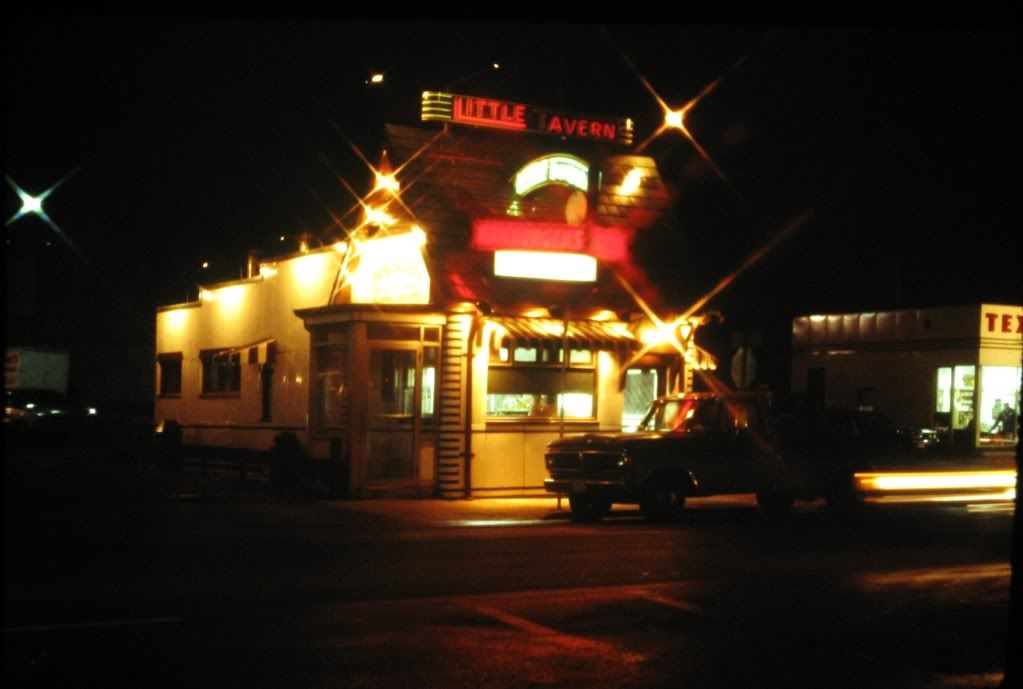
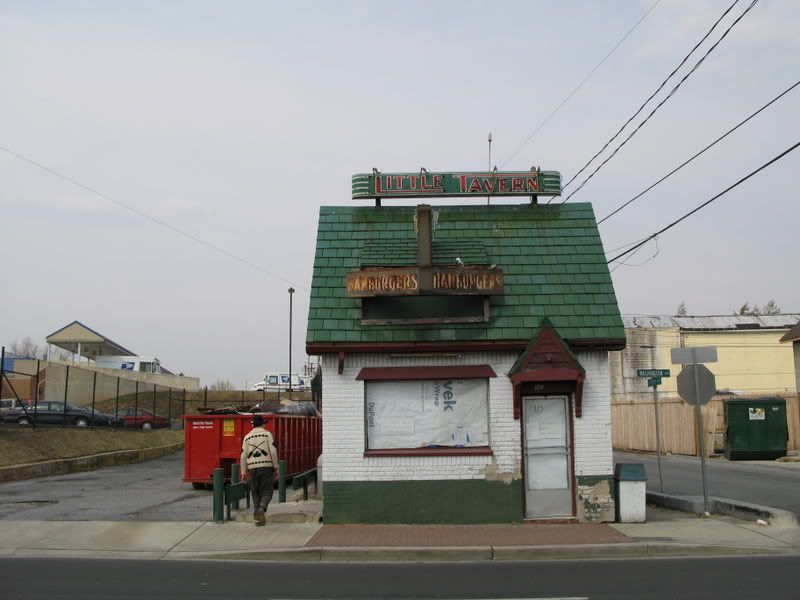
Bethesda, MD Little Tavern

Here are some photos my dad took yesterday of the Bethesda Little Tavern.

From Cerphe of WHFS:
Here’s the deal: i was lucky enough to interview jerry garcia on 3 occasions and one of the times in 1977 at whfs in bethesda, garcia along with several people in his posse along with weasel, a fellow dj on hfs, walked down cordell avenue to the little tavern near the intersection of woodmont and cordell. they had the munchies…go figure.

the group is lumbering down the sidwalk when suddenly approached by several stoners whom intently stare at them, eyes dialate and collective jaws drop. after being speechless for a moment…one points and says………..’look……….it’s WEASEL……..!’

the stoners didn’t even notice jerry garcia, but it was a very big deal to see weasel. like ships passing in the night, the two groups went their separate ways, garcia remained invisible and managed to get his little tavern burgers , return to the studio and join me on my show.

couple footnotes…being vegetarian, there wasn’t much for me to eat at club LT, so i hadn’t put in a lobster lollie or burger order (ha!) AND seeing as i couldn’t leave the studio (i was on-air and not on the sidewalk where this hunter thompson-esque caper went down) i didn’t witness it. the story was told to me after the fact, so some urban legend, revisionist history could be at work here.

at this point, both little tavern AND jerry garcia have left the building…so no harm.

Harrisburg PA diner trip

Despite generally crappy weather, my dad and his friend Steve Rogers, of http://lookingtowardportugal.blogspot.com/, went on a roadtrip from Washington DC to Harrisburg PA.

The West Shore Diner- Lemoyne, PA.

The West Shore is the earliest surviving Silk City diner, and so far as I can tell, the only surviving example of this model, with the demolition of the Miss Jersey City in the 1980s.
More photos of the West Shore can be found here and here.

Please note the narrow width of the diner, combined with the more extreme angles to the ceiling. It’s difficult to tell how much is original to the diner- interiorwise I would say not terribly much, but what is there is old enough to have a character of its own. I would have loved to have seen this diner when she was new.

Steve with an enormous, incredibly inexpensive plate of cream chipped beef

Bison Auction

Wonderful WPA-era frieze of livestock on the side of the building in which the bison auction was held.

Bison

Subway Cafe
This was just a picture stop, but it has a nice neon.

State Street Bridge
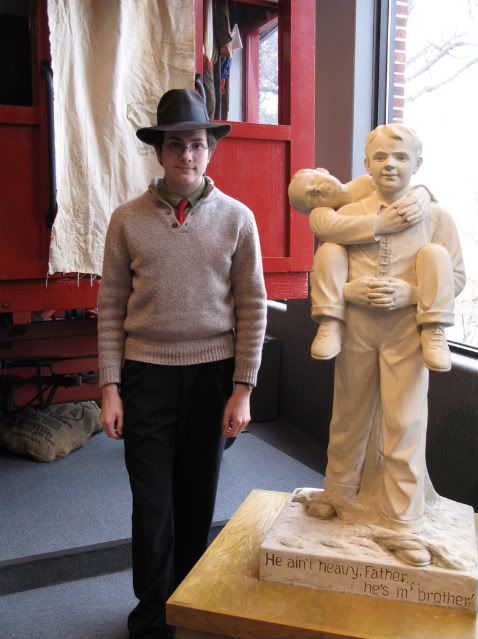
The eagles were carved by one of my ancestors, Ira A. Correll, who also carved the “He Ain’t Heavy, He’s my Brother” at Boystown, NE in addition to many many more sculptures. Unfortunately, the bulk of his work was never signed, so it is difficult to track down.

American Dream Diner

Wolfe’s Diner

Just down from Wolfe’s