A-1 Diner- Gardiner, Maine

The A-1 is one of my all time favorite diners. Great food with an excellent selection served in a beautifully maintained Worcester semi-streamliner in a unique location.

After debating between the South of the Border Burger (with chili and pepperjack) and the North of the Border Burger (with cheese and Canadian Bacon), I picked the North, I figured it was appropriate. My dad got a plain hamburger.
The burgers were big and juicy, the fries were fresh and hand-cut. For dessert we had a slice of oreo cheesecake.

Photobucket
Front of diner with flowerboxes.

Photobucket

Photobucket

Photobucket

Photobucket

A-1 Diner website

Gilley’s – Portsmouth, NH

Today started the long drive back to school, from Maryland up to Halifax, Nova Scotia, by way of Gray and Bangor Maine. We take the drive to Gray, Maine every other year or so, to stay at the old family camp, but have always timed it wrong to make the stop in Portsmouth for the legendary lunch wagon.

Photobucket
A vintage photo from my collection of Gilleys with owner Bill Kennedy.
If I recall correctly, the article is from 1957.
Caption states: “The Night Lunch is an old, old Portsmouth institution. For more than 75 years, the mobile diner has parked on market sq. and old timers await its arrival to buy their franks and beans. Once pulled by horses, a tractor truck now deposits it here each night and picks it up in the morning. Owner Bill Kennedy has run it for 45 years.

Photobucket
Interior looking towards kitchen

Photobucket

Photobucket

Photobucket

Photobucket

Photobucket

Photobucket

The current diner was built c.1940 by the Worcester Lunch Car Company, and stays true to the earlier style lunch wagon floorplan, with the small kitchen on one side, and a couple of stools on the other. It was originally brought to the square and left. Later, it was mounted on a truck, upon which it still rests, although its traveling days are over. A complimentary barrel roofed addition was attached to the right hand side of the car in 1996. The diner is in remarkably good shape, retaining it’s original wood and enameled panels inside. The beautiful original vent hood still gleams.

As it has for nearly a century, the diner still turns out good food, inexpensively, and is open late.

The menu is limited, as it should be, to what can be cooked behind the counter at the grill. Hamburgers, dogs, grilled cheese, fries, etc. I ordered the chili cheese dog. Excellent natural casing dog, with a nice crisp to it when bit, on a squishy bun, covered in chili. It was almost impossible to eat without wearing it, but oh so delicious.

Friendly place, great food, served in a rare and well preserved lunch wagon. What more could I ask for?

Big Guitar- Bristol, VA/TN

Bristol, the birthplace of country music, is home to great architecture, neon, and at least two giant guitars.

The Grand Guitar, an enormous Martin
Photobucket

The fret markers are windows, as is the sound hole. It looks like it could stand to be re-strung.

Photobucket

Photobucket

Photobucket

And in town, is another large guitar, set in the ground, as a chamber of commerce / welcome sign.

Photobucket

Abandoned Pennsylvania Turnpike

Photobucket

On Monday, my friend and I loaded up the car and made the two hour drive to Breezewood, PA, a “Traveler’s Oasis”, the “Town of Motels”.

My fifteen year old bike rack popped a few of the mounting hooks along the way, but the bikes were still there when I pulled into the gravel parking lot at the Pike2Bike trail head.

I’d found out about this trip in a bit of an unusual way. Earlier in the year, my next door neighbor in my dorm had been listening to a Bloodhound Gang song on repeat. She showed me the video, and what caught my attention was the location where it was shot. A little bit of googling later, I’d found one of the many websites about the abandoned Pennsylvania turnpike. I emailed my friend about it, and plans were set in motion.

Not too soon after starting out, we spotted the first tunnel, Rays Hill Tunnel, the shorter of the two. We climbed to the top of the tunnel, climbed down a metal ladder, and in through a broken window. We found ourselves in the ventilation room, with its two large ventilation fans. We explored a bit in the ventilation shafts, which I must say is one of the most frightening places I’ve been. They’re claustrophobic, pitch black, and echo and amplify all sounds, the shuffling of our feet and the dripping of water filtering through the hill. We made our way through the two other stories of the building, down the rusted metal staircases, and exited through a broken out section of the ground floor door.

Photobucket

Ventilation shafts
Photobucket

Rusty metal and broken glass. What a turn on.
Photobucket

Photobucket

We pressed onwards to Sideling Hill Tunnel, the longer of the two, at 1.3 miles long. You can’t see the light at the end of the tunnel when you enter, and then when you finally do, it never seems to get any closer. The headlights we had installed on our bikes, supplemented by large flashlights didn’t begin to illuminate the place. You could barely see the pavement in front of you to dodge the chunks of concrete that had fallen from the ceiling of the tunnel. We explored both ends of the tunnel, and ate lunch when we arrived at the far end. All the ventilation rooms were the same, aside from the graffiti.

Photobucket

Photobucket

Photobucket

From there, it wasn’t far to the old travel plaza that once was the site of a Howard Johnson’s Restaurant, and the turnaround point.

Photobucket

Passed this guy along the way. My first thought was- hey- let’s get them off the highway. Then I realized where I was.

Photobucket

Photobucket

Photobucket

Photobucket

Photobucket

Photobucket

Photobucket

Rib & Sirloin Restaurant / Sandwich Shoppe – Pulaski, VA

Driving down the highway outside of Pulaski, VA, we spotted the big neon for this place poking through the trees. I couldn’t get the camera out fast enough to snap it, so we took the exit and drove around a bit, until we found it. The motel is still there, though it’s closed. The restaurant isn’t visible from the road, and it’s on private property, so please don’t go searching for it

The motel was once the Days Inn. The last review of it is dated September, 2008, so it closed fairly recently. The restaurant, however, has been closed and abandoned for a bit longer. It is currently condemned. Going by a class of 1963 35th reunion banner still hanging in the restaurant, it’s safe to say that the place closed in 1998 or so.

It’s a great ’60s colonial Howard Johnson’s type place, with avocado green stools and a great rooftop neon.
Photobucket

Overgrown parking lot
Photobucket

Photobucket

Sandwich Shoppe
Photobucket

Blue Paint
Photobucket

Red paint
Photobucket

Shots of the interior. Sorry about the glare, they’re through the windows.

Counter
Photobucket

Left Side Dining Room.
Photobucket

Inside dining room. The “Forever Young” DHS class of 1963 35th Reunion. Possibly Dublin High School?
Candles and coffee mugs still on the tables. Ceiling is caving in.
Photobucket

Abandoned Road
Photobucket

Laurel Diner

I found another matchbook view of the Laurel Diner, which I believe shows an older diner which the current Comac replaced. If you have any wild guesses as to builder or date of the diner from the matchbook, please throw them out there.

Frustratingly, it’s just a drawing on the matchbook, but it seems too specific to be stock art, and I haven’t seen the design on any other matchbooks, so I’m going to assume it’s at least fairly representative of what was there.

Note the doors at both ends. The rooftop sign advertises it as both a diner and a bar.
Photobucket

Matchbook design is mostly the same, but diner is different and it’s billed as the “New” Laurel diner
Photobucket

Postcards showing the early 1950s Comac which later became part of the Tastee Diner Chain. I wish I could find an actual photograph to confirm the earlier diner.
Photobucket

Photobucket

Photobucket

The Old Dog Wagon Puts on the Dog

Photobucket

It started out as a humble imitator of the swanky dining car, but now its menus and marvels have made it into a roadside Ritz

By Gardner B. Soule

THE eating places with the most elaborate menus in the wold, in the fastest service and the most customers are not the restaurants of Paris but instead are mass-produced in U.S. plants.

The roadside diner- the long, narrow, silver-colored affair that looks like a railroad dining car – has become the fanciest, speediest and busiest of eating establishments.

The story begins more than 60 years ago, in 1892, the year Charles Duryea successfully operated the first gasoline driven horseless carriage in America. In that year a man named Charles Palmer started using horse-drawn wagons to carry hot frankfurters and beans to workmen in Worcester, Mass., factories.

What grew out of Duryea’s invention is well known. What came from Palmer’s idea is not. But as Americans took to the highways, the diner took out after the cars, and by 1953 the diner was as different from Palmer’s dog-and-bean wagon as a 1953 Cadillac is from Duryea’s gasoline buggy:

– Instead of Palmer’s menu of two choices, the 1953 diner has a menu that may run to six pages and include lobster Cantonese, crepes Suzette and champagne.

– Instead of taking the time that the Greasy Spoon used to require to prepare a meal, the 1953 diner is engineered to get the average customer in, fed and out in 20 minutes.

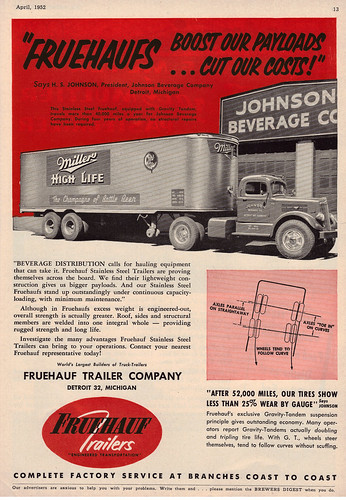
– Instead of peddling food to workmen only, the 1953 diner caters to men, women and children, even to clubs. It caters to truck drivers still (although the tip-off to a diner’s popularity is no longer rows of Freuhaufs but a parking lot full of Fords, Buicks – and up). It caters, above all, to families.

– Instead of functioning at night only (this got Charles Palmer suspected as the operator of a sinister trade), the modern diner is open 24 hours a day. “We don’t have a key,” says Martin Rich, who owns a diner near Port Chester, N.Y., on U.S. 1 ” I forgot where I put it.”

– Instead of being an establishment of doubtful hygiene, the 1953 diner has steel counters, leather or plastic seat covers, terrazzo floors, chrome decorations and a plastic ceiling. All- including the ceiling- can be wiped clean instantly with a damp cloth.

– Instead of seating six or eight persons at a counter only, as Palmer’s wagons did, the modern diner has tables, booths and counters, and seats as many as 137.

– Instead of being carpenter built wooden wagons, today’s diners are stainless steel, chromium plated, air conditioned, fully insulated, fluorescent lighted, deluxe eating establishments with as many accessories as a 1953 automobile. They are constructed on assembly lines with power tools, largely from prefabricated parts.

The man who changed the wooden lunch wagon into a streamlined steel car was a New Yorker named Jerry O’Mahony. He ran a diner a 7th Ave and 34th Street in 1913. Did well, too. Made $1,380 that year. But customers asked where he got his wooden diner. So he had his carpenter build some, and sold them for $300 each ($6461 in 2009). Then he kept on building diners.

Today Jerry O’Mahony, Inc. of Elizabeth, N.J. is the biggest of about a dozen companies making diners. Others include Silk City Diner, Inc., and Paramount Diner Corp. at Paterson, N.J. and Kullman Dining Car Co. at Harrison N.J. New Jersey is the state that makes the diner.

Prices Have Gone Up

O’Mahony’s prices have gone up. “Our diners,” the company boasts, “are the most expensive you can buy.” Selling prices start at $36,000 (34 seats) and go up to $110,000 (those 137 seaters)

An O’Mahony diner is delivered to its owner complete: with sinks, stoves, refrigerators, walk in freezers (a diner buys a side of beef at once), plumbing, air conditioning, heating, automatic dish washers, steam tables, phone booths, counters, stools, pots, pans, waitresses uniforms, china, napkins, silverware, toothpicks, rest rooms, fudge pumps, food warmers, and juke box outlets offering a choice of up to 100 records.

O’Mahony will include television sets if you insist, but doesn’t like to. TV keeps the customers staying longer than that 20 minutes without increasing the money they spend.

Some O’Mahony diners come with a private mahogany office for the owner, complete with built in shower.

The prospective owner usually pays only about one-fourth down. The O’Mahony company has an interest, therefore, in the owner’s success and checks the proposed location before it sells every diner. Traffic past the proposed site is surveyed.

The prospective owner is combed over pretty hard, too. O’Mahony won’t sell to an absentee owner because, with an absentee, more food goes out the back door than out the front.

If a location fails to pay off, a 1953 diner can be jacked up, put on wheels and hauled to a more promising spot. But so thorough are these surveys that not one O’Mahony diner has had to be moved in the past 10 years. Instead, bigger diners are continually replacing those whose business has outgrown them.

$1,250 a Week

An owner’s possibilities for profit are better than Jerry O’Mahony’s were in 1913. Today the net may run $1,250 a week. “Financial security,” says an O’Mahony circular, “is yours for the asking.”

Martin Rick, who runs the Old Post Grill diner on U.S. 1, has gone out after that financial security with an O’Mahony diner. His menu is almost as long as the highway. He sells coffee only and also five-course dinners. He specializes in Hungarian goulash and seafoods. He offers your choice of salads, cold cuts, sodas, sundaes and a dozen categories of desserts. You can wash all this down wish champagne ($6 a bottle) or with anything else. Here Rich’s is different from the typical diner, which does not serve liquor.

The kitchen at Rich’s is a masterpiece of compactness. All cooking apparatus is condensed into a space the size of a truck body – friers, baking ovens, short order grills, heavy duty ranges, sinks, storage. The only food prepared in front of the customer is ice cream dishes.

None of Rich’s waitresses has to walk more than 34 feet in any direction to fill an order. This allows Rich to maintain that 20-minute schedule, an important factor with the average check around 60 cents. His 92 seat diner has fed 2500 people in one day

Diners Heading West

Observing the success of Rich and others, the O’Mahony company is expanding. It has just opened a plant in St. Louis, the first one to mass produce diners west of New Jersey. Transportation costs from the factory to a site are high, and most of the 6,000 U.S. diners are in the East, near the New Jersey factories. But soon, the company hopes, O’Mahony steamlined diners will dot highways everywhere.

In the West, diners will have to compete with deluxe drive ins which are rare in the East. No problem, a diner executive said. Drive-ins have limited menus, he insisted, and predicted that diners would beat them.

Customers Come in Limousines

What the company doesn’t add, enterprising owners will. One owner in the East put Baked Alaska on his menu and became a success. Dozens of owners have added tablecloths and freshly cut flowers to their tables. This has worked so well at one diner – in Aberdeen, MD – that three regular customers arrive daily in chauffeur-driven limousines.

But a diner out on New Jersey 29 has added the crowning touch – a headwaiter, complete with tuxedo, who seats the guests. Yet if you approach this headwaiter in shirtsleeves, in overalls or behind a day’s growth of beard, he will seat you promptly and won’t even raise an aristocratic eyebrow.

Photobucket

Photobucket

Photobucket

Photobucket

Photobucket

Photobucket

Photobucket

Photobucket

Photobucket

Photobucket

Photobucket

Photobucket