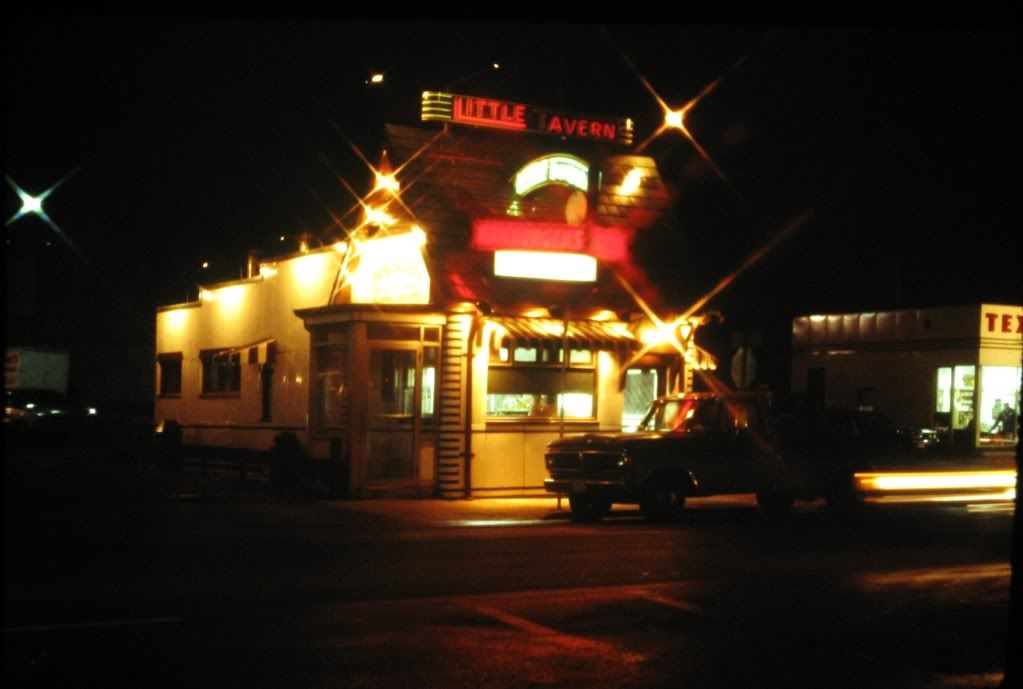
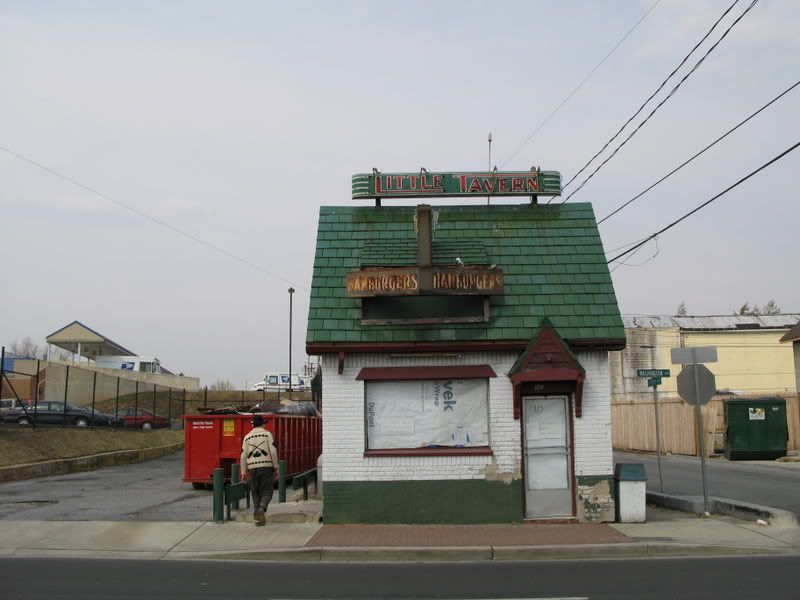
On this day in 1927, the Harry F. Duncan opened the first Little Tavern shop at 510 West Broadway Louisville, KY.

Image courtesy Larry Collier

On this day in 1927, the Harry F. Duncan opened the first Little Tavern shop at 510 West Broadway Louisville, KY.
Image courtesy Larry Collier
East. 25th Street, Baltimore, MD.
I have a much stronger feeling about it having once been part of the Little Tavern Shops chain.
If it was a Little Tavern, it has obviously been covered in stone since its construction, and that remodeling was done some time ago. For a better picture, please look HERE
Still, the design similarities are striking. The window placement throughout the structure is consistent with Little Taverns, as is the window division, into tall panes instead of simple plate glass. Windows are inset with regard to the stonework in such a way as to lead me to believe that the stone was added over top the building. I’ve seen it time and time again with diners and it yields the same basic appearance. If this is in fact a former Little Tavern, it appears the window was narrowed from four to three panes. The plan and section appear consistent with Little Tavern design as well.

The gable over the front door is consistent with the early ’30s Little Taverns in that it is larger and broader than those found on later taverns. See Baltimore No. 5 for the larger version, which extended up four rows of roof tile as opposed to the 2 rows of tile found on later Little Taverns. Granted, there is a bump out around the door not found on Little Taverns, but I believe this is simply the later stonework.

The Stone Tavern’s green enamel lights, pointing at what is currently siding, but on a Little Tavern would have been signage are consistent with what was being put on locations in the early 1930s.

Right across the street from a Little Tavern operating as “Pizza Deal”. As the stone tavern design appears consistent with the design found on the earlier Little Taverns, I would wager that this is Baltimore no.4, opened March 21, 1931, Closed 1932 due to lease problem. The “Pizza Deal” location looks like a later tavern, from the ’40s or possibly as late as the 1950s.

N. Charles St and 26th Street, Baltimore, MD.

The brick construction is consistent with Little Taverns, which were brick/cinder block until c.1935. Later enamel ones were of brick/cinder block construction with paneling added over top. In some cases, they lost their panels later in their life, exposing the underlying brick. The Laurel Location (with) and (without) and Washington no. 24 both show this.
The roof pitch seems appropriate for Little Tavern, as does the general shape of the building, with the tudor cottage section in the front and the extension off the back. The door and front plate glass windows appear to be later additions and adjusting the contrast, it appears there may have once been a window on the left side, as there would have been on an LT.
Still, the scale looks slightly off- Little Taverns were generally a bit taller in the body of the building, and as a rule did not have chimneys. Until I find evidence otherwise, I’d say this one is not in fact a Little Tavern, but it was built at the same time period in a very similar style.


Also in the area with a similar form, but never a Little Tavern as far as I can tell. Much more of a colonial thing going on rather than Tudor.

Despite generally crappy weather, my dad and his friend Steve Rogers, of http://lookingtowardportugal.blogspot.com/, went on a roadtrip from Washington DC to Harrisburg PA.
The West Shore Diner- Lemoyne, PA.
The West Shore is the earliest surviving Silk City diner, and so far as I can tell, the only surviving example of this model, with the demolition of the Miss Jersey City in the 1980s.
More photos of the West Shore can be found here and here.

Please note the narrow width of the diner, combined with the more extreme angles to the ceiling. It’s difficult to tell how much is original to the diner- interiorwise I would say not terribly much, but what is there is old enough to have a character of its own. I would have loved to have seen this diner when she was new.

Steve with an enormous, incredibly inexpensive plate of cream chipped beef

Bison Auction
Wonderful WPA-era frieze of livestock on the side of the building in which the bison auction was held.

Bison


Subway Cafe
This was just a picture stop, but it has a nice neon.

State Street Bridge
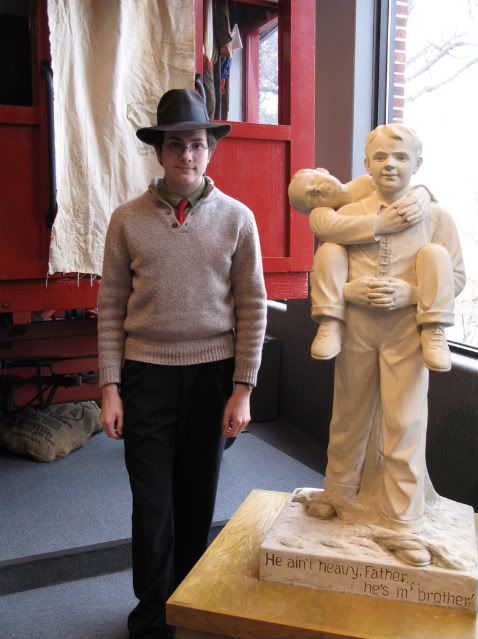
The eagles were carved by one of my ancestors, Ira A. Correll, who also carved the “He Ain’t Heavy, He’s my Brother” at Boystown, NE in addition to many many more sculptures. Unfortunately, the bulk of his work was never signed, so it is difficult to track down.


American Dream Diner

Wolfe’s Diner


Just down from Wolfe’s

I ran across quite a few diner photos which I haven’t published- I’m going to try to work my way through them over the next couple of months.
I visited the Ace in 2006 with my father and Randy Garbin, of Roadside fame.
The diner is an extensively remodeled Silk City. One listing I have for it says it was built c. 1938, the other that it is from the ’40s.
Though it was remodeled extensively, which outwardly conceals its true nature, inside it is all diner.
The fresh baked bread at the Ace would alone be worth the stop.


A picture, courtesy of Brian Butko, of the diner before it was remodeled. Please visit his website and his blog, Lincoln Highway News.

I got some photos today from my dad, who went down on a food and photo safari this morning. All photos are copyright Michael G. Stewart.
Golden Bull – Liquor


Ohio Restaurant


This building will become a trolley station for the new line.

My dad

Uneeda Biscuit


S and S shoe repairing

Hen Lung Laundry

A friend sent photos of this former Little Tavern, located at 2537 Pennsylvania Avenue, S.E., Washington, D.C.
According to Library of Congress records, it was built in 1948; Architect Charles R. Zeller. Another record of it, “Working drawing showing assembly of porcelain enamel cladded panels for fast food restaurant as elevations, diagrams, and axonometrics projections”, exists from 1955. According to that record, it was Little Tavern Shop #24


I visited the College Park location today, seen here while still in operation. Last I visited, it was a BBQ place called JD’s Roadhouse. Before that, it was the “Toddle House”, as was the Bethesda Location.


Some photocopies of photographs, courtesy of SallyAnn Rogers, of the College Park MD Little Tavern. Note the Blue Sky Puppet Theatre performing across the street in front of the book exchange.


A shot from the Maryland Inventory of Historic Properties

While at the new years day party of some good friends (and fellow roadside enthusiasts), I spotted this Little Tavern mug amongst their collection. They were kind enough to allow me to photograph and post it.


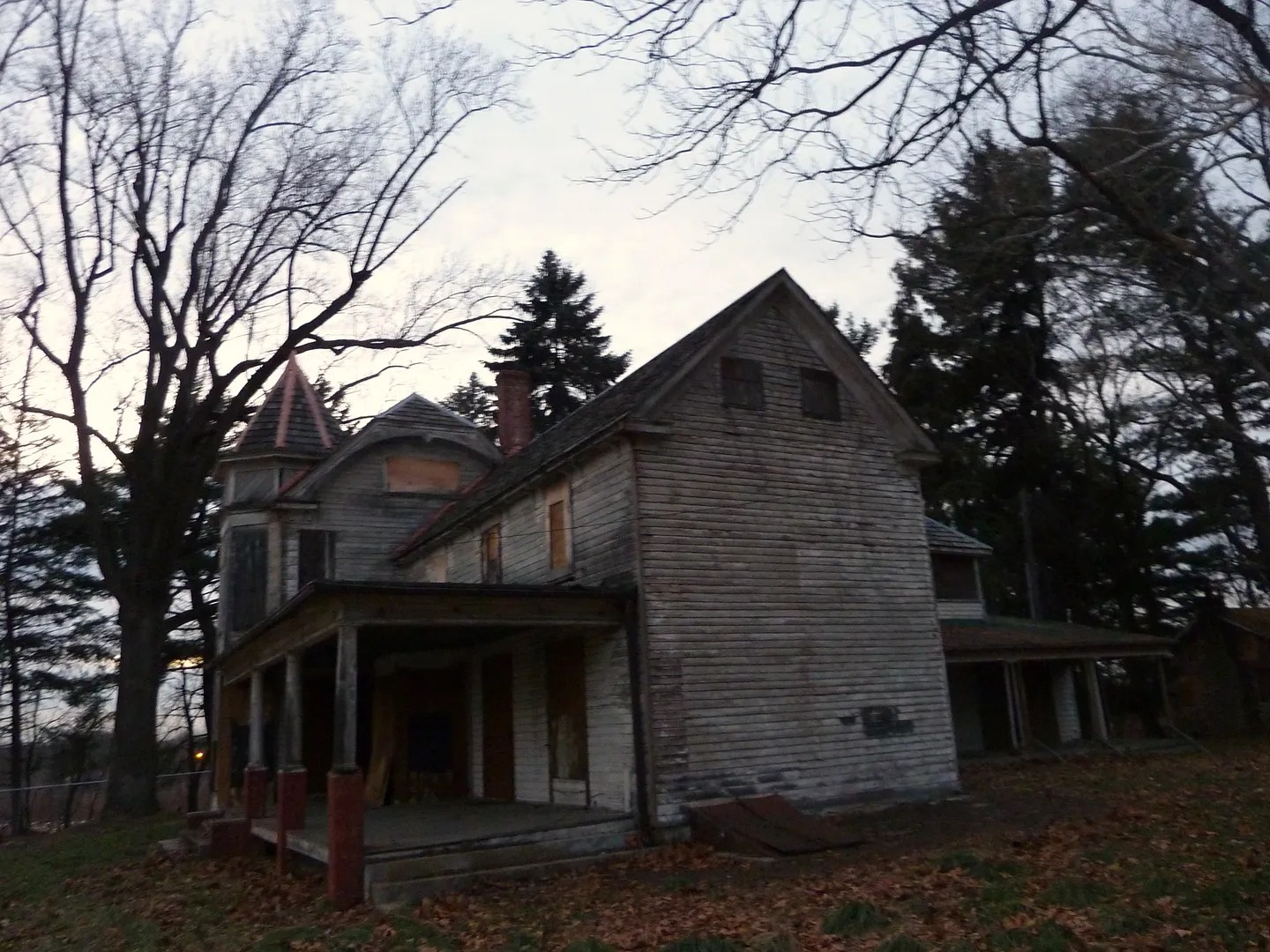
While out driving around with a friend of mine, we spotted a glimpse of this gem through the trees. Parking the car, we hiked through a good stretch of brambles and came upon this incredible house. Unfortunately, as is so often the case it seems, the light failed on us. Another trip is in order. If not within the next three days, then in the summer, provided it’s still standing then.
The History can be found here.



My buddy Zach, wheelman for this trip, in front of the barn.


The Cashell farm, constructed circa 1860 with a Queen-Anne addition, was previously surveyed by the Maryland- Capital Park and Planning Comission and was designated as a historic site by the M-NCPPC in 1984, in the Master Plan for Historic Preservation. Though the property retains the integrity of its architecture and setting, the buildings suffer from deterioration. The owner of the property has boarded over the first story windows of the main house and has not taken measures to maintain the secondary structures. Since the last survey, at least two wooden barns have collapsed. Two wooden barns, two hay storage buildings, two silos, a tile sided storage building, a garage, a shed, the main house, a stone building and two tenant houses still remain. The outbuildings associated with the main house, as well as the two tenant houses were not mentioned in the previous survey form and a description of these structures follows. The secondary structures of the Cashell farmhouse are in a semi-circle arrangement on the east side of the house. A paved driveway passes the front, or south elevation of the main house, the begins a large curve around to the rear of the main house. Along the south side of the curve are a general-purpose barn, two hay storage buildings and a livestock barn. At the east end of the curve are two tile silos and a 1 story concrete/tile storage building. The north side of the curve has a garage and a shed. To the rear of the main house is a 1-store, side-gable house.
J.H. Cashell (Grantham) Farm- 5867 Muncaster Mill Rd.
The earliest section of the frame Cashell Farmhouse, in the American farmhouse style, was built in the mid 19th century by the Hon. Hazel H. Cashell. His son John H. Added a turriculated, jerkin-headed- Queen Anne block at the end of that century.
Important for its association with the Cashell family as well as the high level of architecture archieved by the hybrid-style building.


 Diner Hunter