Another one from the archives- the Columbia Drive In, Columbia, PA. This photo is from March 2004. The drive in would only last one more season, closing in 2005. It is now gone.


Another one from the archives- the Columbia Drive In, Columbia, PA. This photo is from March 2004. The drive in would only last one more season, closing in 2005. It is now gone.
I’ve been working on moving the contents of all my old photo CDs over to my external hard drive and have been finding some gems, older photos that haven’t seen the light of day in almost 15 years.
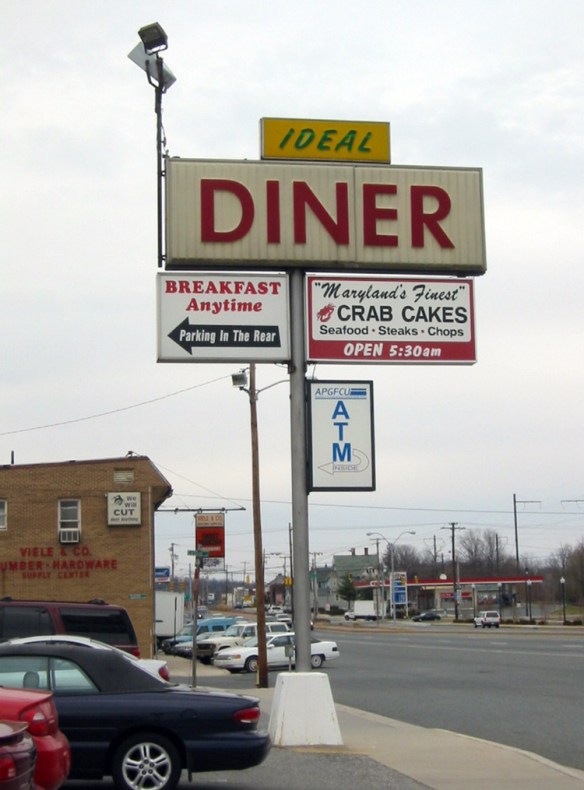
Here are some shots from Aberdeen’s early 1950s O’Mahony, the New Ideal, taken in March of 2004, when it was still open. Unfortunately, this large diner, formerly a Rt. 40 favorite, has been closed since 2011.
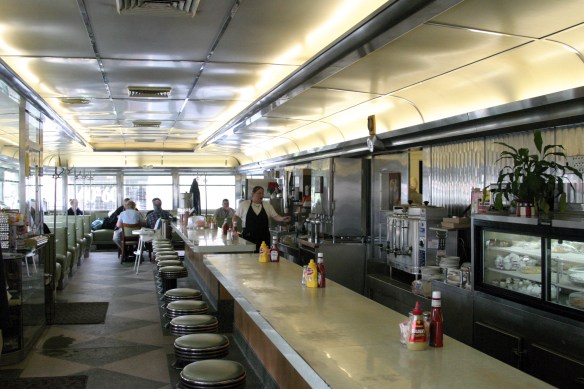
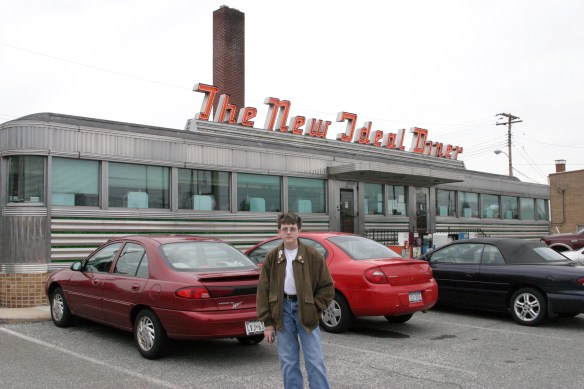
Boy, don’t I look happy (and look how young I was!)
The Ablah Hotel Supply Co. was based in Wichita, KS and built small metal diners in the 1930s, a precursor to Valentine.
Tiny Castle Hutchinson, KS
Pullman Diner 401 S. Broadway Wichita KS
Penguin Grill Wichita KS
Van’s Pig Stand 2111 E Central Ave. Wichita KS (Now the site of Linda’s Second Look Store)
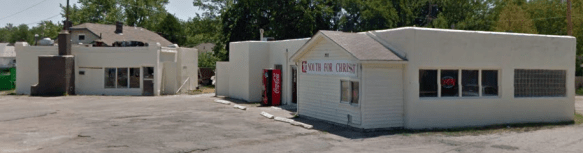
Hob Nob Grill 515 E. 2nd Wichita KS
Peterson’s Coffee Shop 512 W. 2nd Wichita KS
Hale’s Cafe 1852 N. Broadway, Wichita, KS
Continental Grill No. 1 3125 E Central Ave Wichita KS
Continental Grill No. 2 3012 E Douglas Ave Wichita KS
Continental Grill No. 3 Wichita KS
Osborne’s Drive In Wichita KS
Little Palace Lunch No. 1 3037 E. Douglas, Wichita, KS
Little Palace Lunch No. 2 Wichita KS
West Urn Grill Wichita KS
Spot’s Grill Augusta KS
Little Kastle Lunch Eureka KS
Little Kastle Lunch No. 1 Emporia KS
Little Kastle Lunch No 2 Emporia KS
Price’s Grill Topeka, KS
John Arthur’s Steak House Kansas City, MO
Little Kastle Lunch Kansas City, MO
Little Castle Lunch McPherson, KS
Little Kastle Lunch Salina, KS
White Palace Inn Hays, KS
McFredericks Grill Russell KS
Dreamland Cafe Rawlins, WY
Rocky Built Hamburgers Denver, CO
Little Kastle Lunch Prett, KS
Harris’ Lunch Kingman, KS
Little Kastle Lunch Hutchinson, KS
Harris’ Lunch Wellington, KS
Harris Lunch Pence City, OK
Little Kastle Lunch Pence City, OK
Little Kastle Lunch Blackwell, OK
Little Kastle Lunch Enid OK
B&L Lunch Winfield KS
Minute Gril Oklahoma City, OK
Lucky Tavern no 1 Oklahoma City, OK
Lucky Tavern No 2 Oklahoma City, OK
Lucky Tavern No 3 Oklahoma City, OK
Mac’s Grill No. 1 Oklahoma City, OK
Mac’s Grill No. 2 Oklahoma City, OK
Little Kastle Lunch Dallas, TX
Tex Inn, Dallas, TX
B&W Lunch Ft. Worth, TX
Rockefeller Hamburgers Dallas, TX
Marshall’s Quick Lunch Lawton, OK
Art’s Cafe Bartlesville, OK
McDonald’s Drive In Pawhuska, OK
George Zervas Drive In Bartlesville, OK
Fred Switzer Cafe Augusta, KS
Little Chief Grill Albuquerque, NM
Silver Castle Lunch No. 1 Tulsa, OK
Silver Castle Lunch no. 2 Tulsa, OK
Silver Castle Lunch no. 3 Tulsa, OK
Sooner Cafe Tulsa, OK
Bordens Grill No. 1 Tulsa OK
Bordens Grill no 2 Tulsa OK
Pepe’s Grill Tulsa OK
Lucky 7 Ice Cream Store Tulsa OK
Lucky 7 Lunch Tulsa OK
White Knight Sandwich System No. 1 Tulsa OK (opened 1936)
White Knight Sandwich System No. 2 Tulsa OK
White Knight Sandwich System No. 3 Wichita KS
White Knight Sandwich System No. 4 Wichita KS
White Crown Lunch Tulsa OK
Shamrock Lunch, Hutchinson, KS
Another Valentine Diners shot from my collection. This photo was originally in the sales portfolio of Valentine salesman O. Glenn Griffin. (1899-1993)
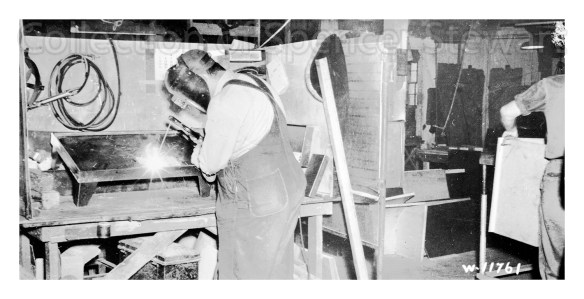
These shots, likely from the late 1940s, show Valentine diners under construction, their metal framing and bracing and a little of their fabrication facilities. Looks like pretty tight quarters in the plant. Since this sales portfolio spans Hayes, Lunch Craft, Valentine Industries, and Valentine Mfg., I can’t be positive as to which one of the several spaces that Valentines were built in these are from.

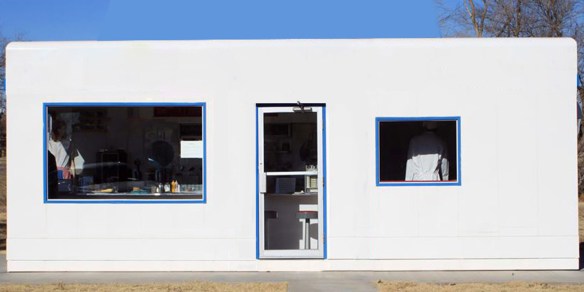 Valentine with detailing removed. Original photo by Michael Engle
It’s remarkable how Valentine was able to have such a wide range of products, with designs spanning decades, all based on what was essentially the same central unit, a more or less featureless, flat roofed white rectangular box. In architecture school, we had a running joke about “applied style”- how some architects just throw materials and detailing onto a form to which those things have no relation. In Montana, the classic example is the mega mansion log cabin. It’s not a lodge, it’s a generic form that “style” has been applied to. In the MT case a log veneer and corrugated metal, but elsewhere, it could just as easily sprout Mediterranean columns and tile work or shake shingles.
The term “dumb box” gets thrown around referring to rectangular skyscrapers or is derogatorily applied to buildings without merit. In this case, I use it as praise. The core of a Valentine Diner is a blank canvas, a module in the most basic sense. While east coast diners kept the basic long low proportions almost from their inception, their forms changed dramatically over the years, from barrel roofs to monitor roofs to stainless parapets and mansards. A monitor roof O’Mahony and a barrel roof O’Mahony, for example, required very different constructions.
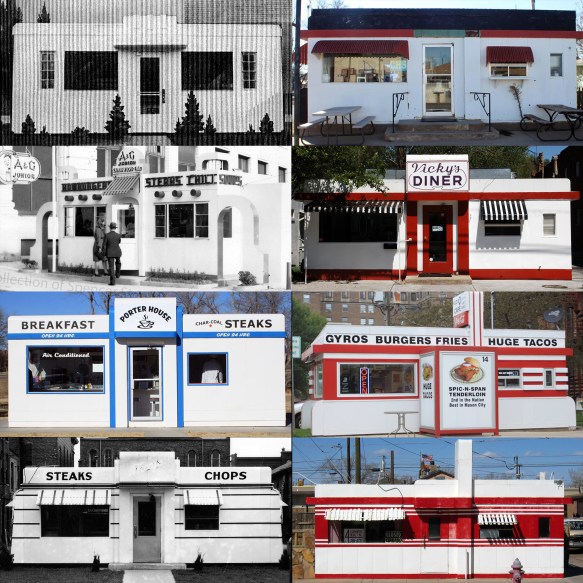
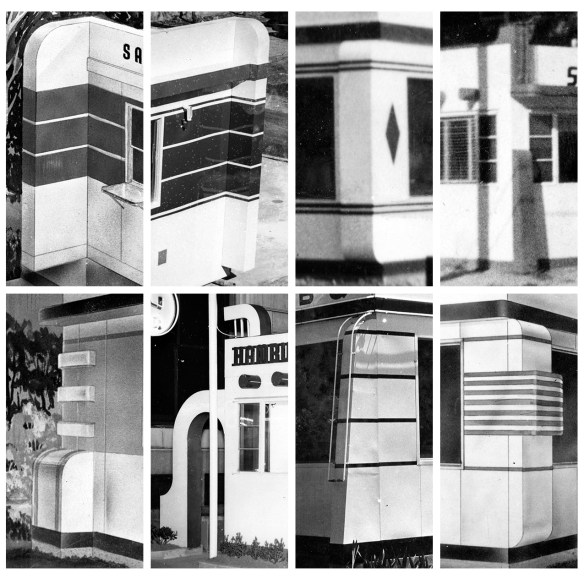
Let’s take a look at the A&G Junior in New Orleans. The overall impression of the building is a moderne take on stucco Spanish Revival architecture, with arched openings and exposed round timbers. It is, of course, metal rather than stucco and wood, with industrial windows and neon, expressing its own identity and function rather than giving in to complete stylism. Look a little closer and you’ll see all those details which give it that spanish revival look are bolted on, stand alone details added to the same central box. Leave that box alone, remove those details and add a tower- instant White Tower. Add a tiered pylon around the door and angled panels where the arches are, you get Neill’s Drive Inn or Foxy’s. Swap those angled panels for shorter straight versions (but notice, they’re the same depth) and you get the Master. Change the parapet a bit, and only bolt on the back panels and you get the Navajo. The striped paint jobs so many of these came with start to define a sense of architectural rhythm. On diners that have been repainted (Winslow , Hershey, Auburn) you’ll notice how much has been lost. The canted sign and larger windows of Cindy’s give it a space age look, but the interior, construction and overall base unit are more or less unchanged since the Hayes built diners of the 1930s.
This also brings up the question of who designed these diners. The promo materials say, “design by Gilbert”, but I believe it’s more likely there was no single person named Gilbert, that this was a reference to Gilbert St. and a way to keep credit for the design in-house and anonymous while still having that “hand of the designer” to put on the drawings. Richard Ten Eyck has been credited with Valentine Diner design. He was attending school for industrial design in 1938-1939, after the Ablah in the layout above (which has the proportions, pylon and basic design that was used by Valentine through the 1940s and 1950s) was designed. But although the bones were in place in the 1930s, the detailing and signage are so much of what make these places unique. Arthur Valentine was credited on the patents which were granted for various designs, but as the owner of the company, that’s not surprising at all, and doesn’t necessarily indicate that he personally designed any of it. The little I can find about Ten Eyck’s involvement that isn’t blogs overstating quotes on other sources says he was only involved in 1948 on the Master model. Other sources say the Aristocrat. If you look at the master model, it’s only the most minor tweak from earlier designs, one stool larger, with the sign turned 90 degrees.
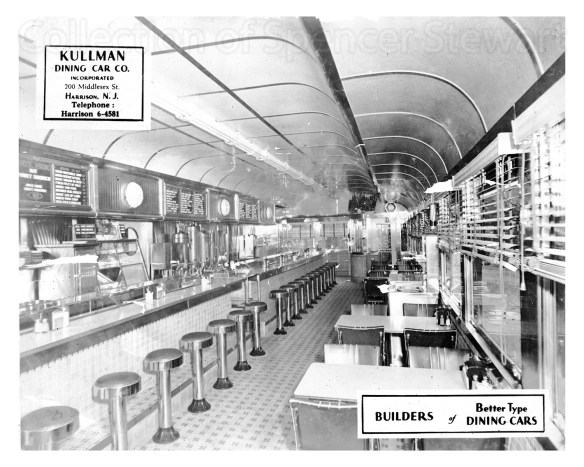
Another Valentine Diners shot from my collection. This photo was originally in the sales portfolio of Valentine salesman O. Glenn Griffin. (1899-1993)
That the Valentine sales portfolio included Kullman advertising makes some sense- In the 1930s, Kullman did good business building “castle turret” dinettes and other small diners, which would have been in at least some degree of competition with Valentine’s earlier iterations of Ablah and Hayes. I haven’t been able to put a firm date on the Valentine sales portfolio because so little is dated and it has at least a decade’s worth of material in it, spanning several companies, but the newest in there is late 1940s at the oldest, which would put this Kullman at roughly 10 years old. With the huge changes taking place in east coast diner design in that postwar period, this model would be hopelessly outdated by that point, and maybe that’s part of why it’s in Griffin’s portfolio. “Now why would you want this giant, expensive, old fashioned kind of place when you could have a brand new, modern, efficient Valentine diner on reasonable terms?”
This last batch of photos was really badly water damaged, stored in early plastic sheet protectors for the past almost 70 years, which trapped water inside, shrunk up, molded and stuck to the image, pulling off chunks from the surface of the picture. I’ve been able to clean up a lot of it in post production, but with this kind of damage, there’s only so much you can do.
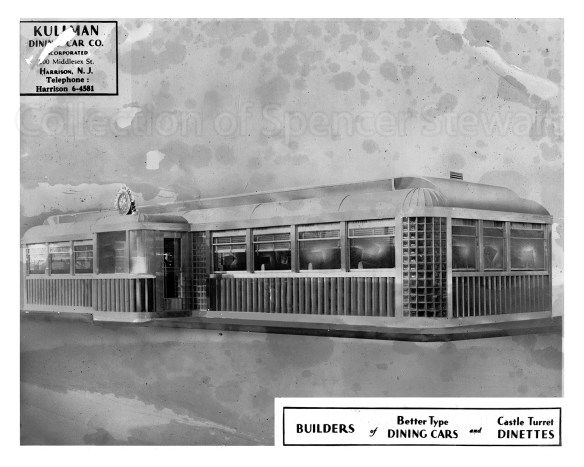
Another Valentine Diners shot from my collection. This photo was originally in the sales portfolio of Valentine salesman O. Glenn Griffin. (1899-1993)
That the Valentine sales portfolio included Kullman advertising makes some sense- In the 1930s, Kullman did good business building “castle turret” dinettes and other small diners, which would have been in at least some degree of competition with Valentine’s earlier iterations of Ablah and Hayes. I haven’t been able to put a firm date on the Valentine sales portfolio because so little is dated and it has at least a decade’s worth of material in it, spanning several companies, but the newest in there is late 1940s at the oldest, which would put this Kullman at roughly 10 years old. With the huge changes taking place in east coast diner design in that postwar period, this model would be hopelessly outdated by that point, and maybe that’s part of why it’s in Griffin’s portfolio. “Now why would you want this giant, expensive, old fashioned kind of place when you could have a brand new, modern, efficient Valentine diner on reasonable terms?”
This last batch of photos was really badly water damaged, stored in early plastic sheet protectors for the past almost 70 years, which trapped water inside, shrunk up, molded and stuck to the image, pulling off chunks from the surface of the picture. I’ve been able to clean up a lot of it in post production, but with this kind of damage, there’s only so much you can do.
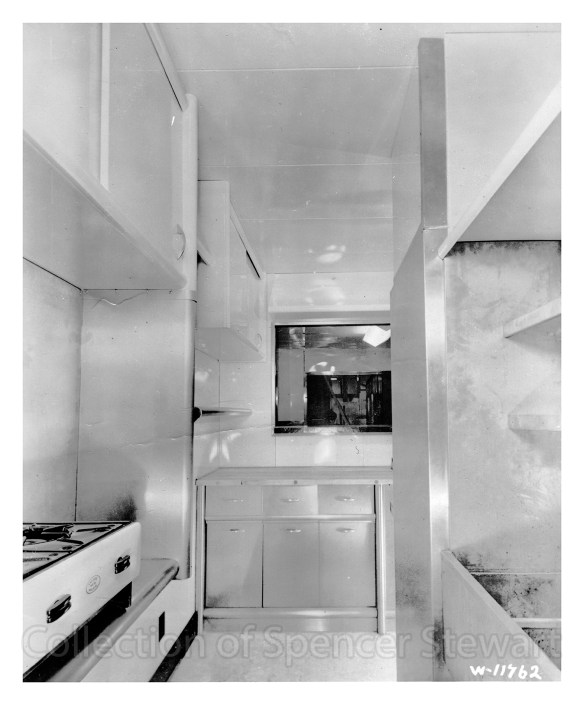
Another Valentine Diners shot from my collection. This photo was originally in the sales portfolio of Valentine salesman O. Glenn Griffin. (1899-1993)
This interior view, all white and stainless steel, taken in what appears to be the factory at night, has an almost abstract quality to it.
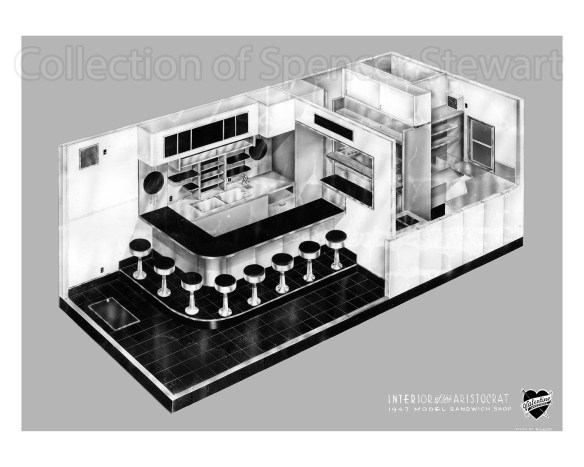
Another Valentine Diners shot from my collection. This photo was originally in the sales portfolio of Valentine salesman O. Glenn Griffin. (1899-1993)
Pictured here is the interior of the 1947 model Valentine Industries Aristocrat model, an 8 stool diner.
Another Valentine Diners shot from my collection. This photo was originally in the sales portfolio of Valentine salesman O. Glenn Griffin. (1899-1993)
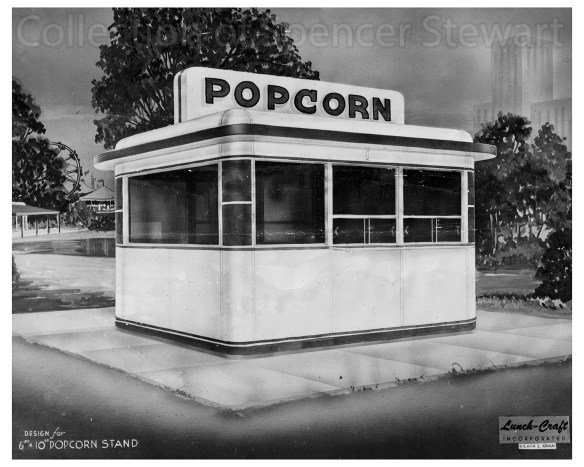
This 6×10 popcorn stand design comes from the short lived Lunch-Craft Incorporated of Wichita, Kansas. The only record of Lunch Craft names O.G. Griffin as the sole officer on record. Since so much of this binder’s contents are Valentine, everything about this, from the photo studio used to make the prints, to the style of rendering, to the “design by Gilbert” are identical to the Valentine Industries promo material of the same era, I don’t know if Lunch Craft was a sub-line of Valentine, or a short lived reorganization, or even a short lived competitor. I’m leaning more towards a c.1945-1946 reorganization, as Valentine was coming out of the war and starting up production again. Hayes Mfg., who had built Valentine Diners, went out of business in 1942, Valentine Industries only lasted 1945-1947, closing when H&H parts, who built the diners for Valentine, switched to building aircraft components. Valentine Mfg., the best known in the chronology of Valentine Diners, opened in 1947. For me, this period of change seems the most likely for a previously unknown name to pop up, then disappear, with novel products, possibly without actually building any of them. I’d also wager that the Gilbert in “design by Gilbert” refers not to a person, but to Gilbert Street, where Hayes (and by extension Valentine) was based in the late 1930s-early 1940s.
 Diner Hunter


