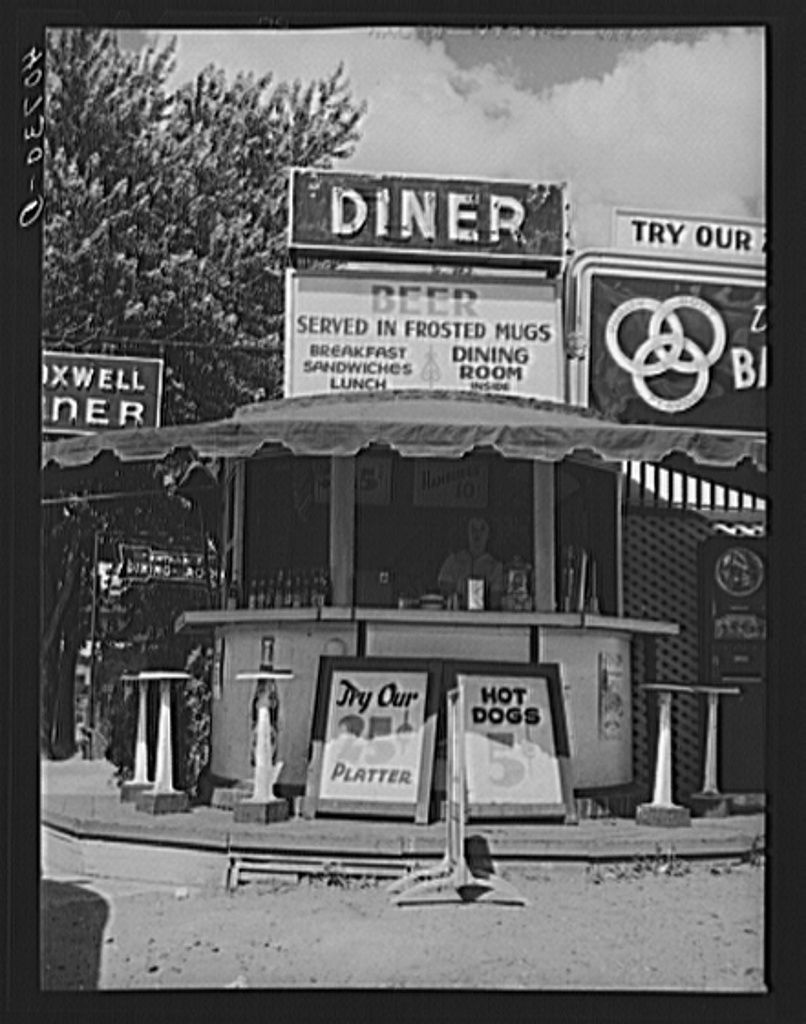
Diner Find: Peter’s Carry Out

You would never know to look at it from the street. For years I’ve been going to Potter’s and Weaver’s violin shop, which share a back parking lot with Peter’s. For years I’ve been going to the Tastee just a few blocks away, and I’ve stood under the awning of Peter’s to shield my camera from glare while taking pictures of the former Little Tavern located right across the street. But for whatever reason, I’ve never looked inside.
Photobucket

But sure enough, back in behind the facade of this little shopping strip lies a surprise. A long row of stools and a barrel roof. Whereas all the other buildings in this strip have basements, Peter’s does not. The barrel roof visible on the inside of the diner, is finished for exterior use on the top side, in a space which is now an attic, with the long ago addition of a flat roof, flush with the rest of the businesses on that street. Google satellite photos show a clear seam on either side of Peter’s. All that confirms that Peter’s was not built on site, but was something “other” from the fabric of the streetscape, brought in from somewhere else and set up.

Now let’s take a look at the building itself. Old newspaper articles talk about Maryland being a haven for streetcar-turned-diner conversions in the depression era. Most disappeared as soon as the owners were able to scrape together enough money to buy a proper factory built diner. Take the fomer State Diner in Baltimore, for example, which was a trolley diner until it was replaced with the current secondhand 1930s Silk City in the early 1950s (the Silk City was the original Laurel Diner- now the Tastee). Here’s another interesting Maryland trolley to diner conversion.
With a trolley conversion, like the White Diner or the Crossroads Dinor you would expect to find curved ends. While the original front wall of Peter’s has been punched out to allow more light from the storefront and more seating, it’s clear that the end walls (the one in back as well) are flat, but with curved corners, which makes me think it is far more likely that this was a factory built-purpose built diner.

Photobucket

The ends of the diner have a curve running perpendicular to that of the main barrel, similar to a Silk City roof, not like, say, a ’20s O’Mahony or Tierney. The roof has a distinctive profile- not a smooth curve, but one that has steeper slopes on the sides and a flatter roof. The closest thing I can think of with this particular roofline is a very early, narrow Silk City model. A surviving example would be the West Shore Diner. There is also an abandoned diner of this Silk City model in Montana (formerly Gordy’s) and the Miss Jersey City diner, now long gone.

Here is a picture of the interior of the West Shore for comparison. The Silk City is wider, but the similarities in the barrel roof are notable. Same profile, same curve at the ends. With all the years of modification and renovation at Peter’s, though, the definition of the barrel profile could have been somewhat lost, making real identification difficult. The shape, though, is undeniably that of a diner.
Photobucket

The backbar gives insight into its history, but not its origin. Custom-Bilt National Toddle House, Inc.
Photobucket

The patent numbers, from 1933 and 1934, correspond to the backbar equipment which was found in all Toddle House restaurants at the time. And sure enough, this building had a long stretch operating as a Toddle House.
Photobucket

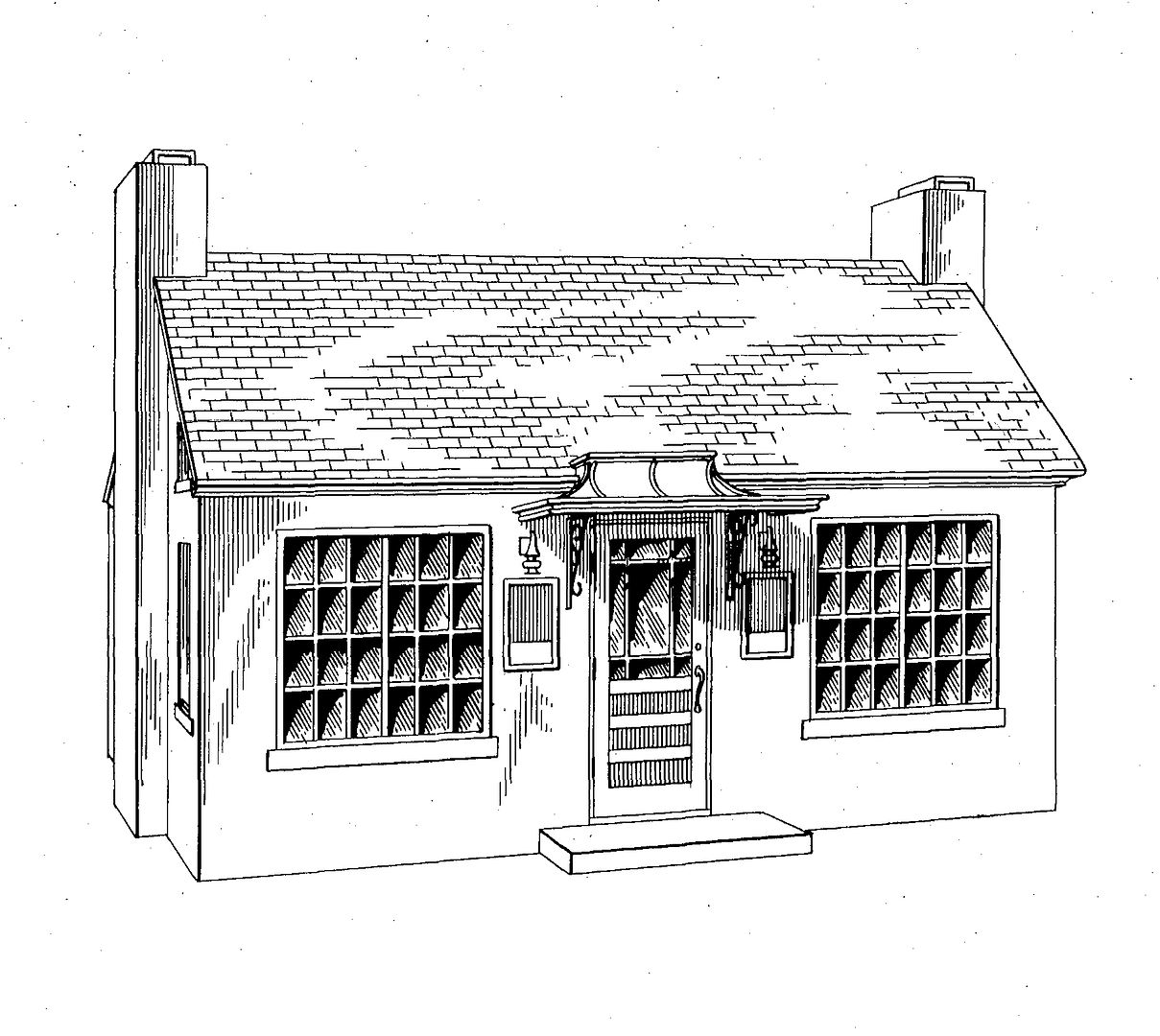
Toddle House was yet another diner-concept early fast food place, similar in its early days to White Tower, Little Tavern, etc. Like Little Tavern, they used a very small tudor cottage style building. While Little Tavern had the counter oriented perpendicular to the front facade, Toddle House had theirs, diner style, parallel to the front. So for a restaurant which was just stools and a grill, it’s easy to understand why, and how they would take over a barrel roof diner like this. It also means that the first of many renovations, disguising the diner’s true origins, took place 75 years ago, when the diner itself was still relatively new.
Photobucket

And here are some news stories from the late 1950s, mentioning it as a Toddle House.

Photobucket

Photobucket

Photobucket

Peter’s Carry out has a website!
It’s located at 8017 Wisconsin Ave, Bethesda, MD 20814

Washington Area trip – Oct 2011

The Georgetown Theatre
Photobucket

The Cellar Door
Photobucket

Paul’s Liquors
Photobucket

A-Frame IHOP
Photobucket

Kennedy Theater: Only the facade remains, with a new building built behind.
Photobucket

Photobucket

Air-Way VIP Room

Abner ‘Sam’ Sampson, D.C. businessman, dies at 78
By Hamil Harris, Published: June 4

Abner “Sam” Sampson, a vacuum cleaner salesman who rose to own a vacuum cleaner franchise and a nightclub, Washington’s “Air-Way VIP Room,” died May 23 of bone cancer at his home in Washington. He was 78.

Mr. Sampson sold Air-Way vacuum cleaners in the District from the 1960s until 2004 and was named Air-Way Salesman of the Year more than once. He sold door-to-door for years and met his future wife on one particularly fortunate house call. In 1978, he purchased an Air-Way franchise in Washington.

In addition to thriving in the vacuum cleaner business, Mr. Sampson expanded his service to selling carpet, drapes and rental properties. In 1978, he opened the Air-Way VIP Room, a banquet hall for birthday parties, anniversary celebrations and church functions. Both the VIP room and the vacuum business closed in 2004.

Photobucket

Little Tavern – North and Charles

I was sent this photo by Rick Smith of http://www.bpinorthavenue.atspace.com/

This storefront Little Tavern was located at 1 East North Avenue, Baltimore, MD
The opposite corner was once home to a similarly styled White Tower. Photobucket

You can make out in the White Tower photo part of the sign of the Little Tavern reading “Hamburgers”

Here’s another photo of this location, from 1960s Little Tavern company documents.
Photobucket

Essex Diner – Essex, MD

Unfortunately, it’s just a quick out-the-window shot. With the way the median in the road was, it would have been a pain to turn around to get a better shot. That road design probably isn’t the best for their business, either. Anyhow- the Essex Diner is a 1993 Starlite, formerly known as Mr. D’s Diner, the Starlight Diner, Casa Luna and I believe a few others. During its Italian or Mexican phase, the diner was unfortunately remodeled.

Photobucket

And here’s a shot of the “other” Essex Diner, closed in 1977, destroyed by arson in 1980.
Photobucket

A much better exterior shot

PA Signage

Overbrook Cafe- York, PA

Take a look at the “Food” neon sign. On the left hand side of the sign, the tubing alternately reads “good” and “food”. The remains of the broken “G” are still visible on the right hand side of the sign. The restaurant itself isn’t much to look like anymore- mansard roof, faux-tudor upper band and brick lower band. Apparently, the Cafe has been around since at least the 1940s.
Photobucket

Photobucket

Print-o-stat – York, PA
This is the corporate headquarters of the printostat company. Great plastic and metal tower sign.
Photobucket

Photobucket

Snow Palace- York, PA
Nice older 3-D sign. Probably originally neon.
Photobucket

Bill Boring – York, PA
Photos on Flickr show this neon still works.
Photobucket

Cold Cases – York, PA
Photobucket

Coach Light Family Restaurant – Shrewsbury, PA
Photobucket

Mason Dixon Oil Company, Emmitsburg, MD
Not so much the signage, but an interesting conglomeration of buildings.
Photobucket

Mike and Travis’s Mountain Shadows Restaurant

The Mountain Shadows Restaurant is a rare Master built diner. It was built c.1950, and has been owned by Mike and Travis since 1981. A picture of them, c.1981, graces the front of the vestibule.

Photobucket

The diner has a brick kitchen addition and dining room addition. A roof has been added later on, which, though it doesn’t obscure any of the facade of the diner itself, drastically changes the look of the place.
Photobucket

Blue transom windows. Old metal awnings.
Photobucket

The owner of the diner.
Photobucket

Inside, the diner is pretty original. The booths have been replaced and the counter re-done.
Photobucket

Really nice stainless work by the menu board. I particularly like the blue flex-glas surrounds to the menus. These diners have a distinctive roofline.
Photobucket

Replacement brown formica and brown tilework
Photobucket

Open faced breaded Veal, mashed potatoes, applesauce, dinner roll and a pepsi.
Photobucket

14954 Buchanon Tr E/Rte 16, Blue Ridge Summit, PA

Palace Diner – Biddeford, Maine

Maine’s Oldest Diner- The Palace Diner, a c.1926 Pollard. One of only two Pollards that still exist.
Photobucket

Blueberry pancakes. Deliciously buttery, with a nice crisp to the outside. Something you can only get from a good diner grill, by a good grillman.
Photobucket

Photobucket

Photobucket

The Pollard diner tag.
Photobucket

Manufactured by Hedlund Food Service Equipment, Worcester, MA.
I can’t find any other record of Hedlund apart from the tag. Take a look at the photo after the one of me sitting at the counter. Hedlund did beautiful metalwork.
Photobucket

Early morning at the diner. Really great coffee. The counter has the marks of years of elbows, years of coffee cups. The ghosts of thousands of patrons. There’s less wear at the ends of the diner, more wear towards the griddle. Everyone wants to watch the show.
Photobucket

Great backbar.
Photobucket

Behind the counter- the men responsible for making this one of my top 10 diners.
Photobucket

A shot of the Palace Diner in the factory, located at 463 Chelmsford St., Lowell, MA.
Note the original panels and the original smaller windows. These were swapped out for larger windows and the current paint scheme you see today.
Photobucket

They’re located at
18 Franklin St
Biddeford, ME 04005

and check out their website.