Letterman’s Diner- Kutztown, PA

We stopped here this morning for a second breakfast, a “short” stack of pancakes and a side of bacon for me, an order of eggs, bacon, homefries for my dad. My short stack turned out to be two excellent pancakes the size of platters, which even I couldn’t finish. The bacon was tasty, the coffee fresh, and the grillmanship exciting.

Outside view of the diner. Though an angled front facade has been added, the complete barrel roof is still visible. You can see where the original front sliding door once was.

Photobucket

Photobucket

Photobucket

Inside view of the diner. Lots of later changes, but the tile work on the counter, the ceiling and the vent hood are original.

Photobucket

It looks from this period photo, taken after the move, that a white painted flat ceiling was added, preserving the original wood barrel roofed ceiling underneath.
Photobucket

Original window at the front of the diner. The other window has been removed to make way for a larger front door.

Photobucket

The ceiling of the diner has this design painted where the seam trim of the ceiling (now missing) meet.
Photobucket

Dan’s Diner of Spencertown, NY- same design.
Photobucket

Vent hood
Photobucket

Photobucket

Photobucket

Photobucket

The owners of the diner say that this is the nation’s oldest Silk City, built in the very early 1930s. Can anyone confirm Silk City as the builder?

Manufacturer of the diner has been confirmed as a O’Mahony.

Compare to this interior photo of Dan’s Diner of Spencertown, NY. Same vent hood, same sliding door (though the Kutztown one’s is gone, it’s visible in the old photos, and the doublewide delete on the wall), and the same ornamentation on the ceiling
Photobucket


Letterman’s Diner @ Dine Indie

Letterman’s Diner MySpace

Stops from May 26, 2009 Diner Trip

Airport Diner – 15110 Kutztown Rd. – Kutztown, PA.
The Airport diner is a 1960 Silk City, serial number 6027, with zig-zag stainless

Photobucket

Philco sign – Pauley’s Electric Shop
Photobucket

222 Dutch Lanes Bowling
Photobucket
Photobucket
Photobucket

Emmaus Bowling Center – 16 Lanes – AMF – Emmaus, PA
Photobucket

Plaza 2331. Dig that plaid.
Photobucket

Trivet Family Restaurant – Breinigsville, PA – 1970s DeRaffele
Photobucket

Trucking Sign- Emmaus, PA
Photobucket

5th Street Diner – Temple, PA. Kullman replacing a Silk City
Photobucket

Giant Penguin
Photobucket

Backside of the Prospect Diner- Columbia, PA, a 1955 Kullman, as seen from the highway
Photobucket

Neptune Diner- Lancaster, PA

I stopped here this morning for coffee, a bagel and a side of scrapple, something I haven’t had access to up at school.

Me coming out of the diner.
Photobucket

Cowcatcher corners.
Photobucket

Inside of diner. Tile floor. Maroon and stainless dominate.
Photobucket
Painted neon sign.
Photobucket

Stools
Photobucket

Backbar
Photobucket

Me- in the diner.
Photobucket

Vestibule with reflection of sign
Photobucket

The neptune was built by Mountain View in 1951, and is serial number 296. It used to be known as the DeLuxe Diner.

DC / MD diner trip – May 24, 2009

This was my first real diner trip in a while. I met up today with Mike Engle, author of Diners of New York; the man behind NYdiners.com, and roadside buff and frequent Zippy the Pinhead contributor Ed Engel at the American City Diner, and headed out from there.

The first stop of the day was the American City Diner of 5532 Connecticut Ave NW Washington, DC. It’s a late ’80s Kullman, one of the early retro-styled diners, and one of the ones that did it right. For some photos as it appeared when new, click here. Since then, it’s been added on to, with a large side addition, and a front porch which obscures everything to the left of the vestibule.
Photobucket

The Left side of the diner- 2009
Photobucket
The left side of the diner – 1989
Photobucket

The former Howard Theater. Great rusty marquis on this one.
Photobucket

Photobucket

The now abandoned Wonderbread / Hostess Factory

Photobucket

Photobucket

Ran into a little excitement along the way between these two stops, but all’s well that ends well.

Northeast Academy of Dance Neon sign. Look at the detail at the left hand corner of the sign.
Photobucket

We hit up the Capital City Diner, which was moved here on the 20th. Watch the video of it being moved. This Silk City, formerly of Avoca New York, has made its way to the Trinidad neighborhood of Northeast DC.
Photos at its original location and some backstory can be found at :A Real Historic Diner Coming to DC!

Photobucket

Photobucket

This next leg of the trip had some neat neon and signage

A&R Auto Parts
Photobucket

Syd’s Drive In / Liquor
Photobucket

Cross Roads
Photobucket

Tesst theater
Photobucket

Hyattsville Hardware / Franklin’s
Photobucket

Calvert House
Photobucket

Silver Spring’s old Canada Dry bottling plant
Photobucket

A quick stop at the Silver Spring Tastee was made.

Now
Photobucket

Then
Photobucket
More old photos can be found here.

Then a side trip to Forest Glen, parts of which have deteriorated greatly since my last visit.
Photobucket

Photobucket

Photobucket

Dinner at the Tastee Diner in Bethesda
Photobucket

Then
Photobucket

And the trip’s final stop at Bethesda’s former Little Tavern. A 1990 photo of it, when it was still a Little Tavern, can be found on the Diner Hotline.

Photobucket

Photobucket

Tierney Diner Ad – 1926

Photobucket

No matter what your present occupation, or where you are located- if you have been seeking YOUR opportunity; if you have been anxious to get into business for yourself- to be your own Boss- or if you are in business and dissatisfied with its results; if you want to make more money than you ever made in your life- if you are willing to work and win success- then a Tierney diner is YOUR opportunity. It’s a clean, respectable PROFITABLE business for YOU- Every day in the year!

You would be one of the most independent men in your community. Your money would be turned over quickly. 30% – 40% of each days receipts would be your NET profit! You would have a strictly cash business. No bad accounts. No collections to make

The Dining Car business is spreading fast. Men like yourself, and with no more experience at the start, are getting rich in it. You can do it, too!

* * *

A Total capital of $3000 ($36,000 in 2009 $) – will set you up in this business- provide the first payment on your car and leave enough to install it on location, open it up and start your daily receipts coming in- and many successful operators have done it on less.

* * *

YOU CAN START
The Dining Car Business in your own town.

The Tierney Real Estate Department checks up your location, or obtains one for you, thus assuring a proper business building location for your car.

We train you for success, just as we have trained hundreds of other operators of Tierney Diners.

You can take advantage of our Training School, if you desire.

Tierney service helps you in all details of operation, providing reliable and experienced chefs, and other employees, if desired, and supervises and guides your management, if needed, until you are sufficiently experienced to assure success by yourself.

no Tierney Dining Car located and operated in accordance with Tierney Service and Instruction need ever fail, for when you purchase a Tierney Diner you get back of you thirty years of successful experience in this business.

* * *

Tierney Service makes Monthly Payment Plan possible. The Lunch Car business is essentially a worker’s business. It has not been built up by capitalists, although it has created capital for its operators- but has won out through the energy and close attention to business of men who with a small amount of money to start with have followed up that moderate capital with an unlimited supply of conscientious, faithful work. That is what makes the Lunch Car business such a sound, dependable business to be engaged in; it is built on foundations of individual industry and common honesty.

“Fully ninety-five per cent of the hundreds who have won success and independence in this business have started with very little money, so the plan had to be devised to help these men get there cars as well as stand by them until they had made a success of the business. In other words, after you have made your first payment down, the car will pay the balance.”

* * *

Wherever you see a Tierney dining car you will find a man who is making money.

* * *

This portable restaurant is delivered on its own wheels to its permanent location, where connections are made for water, sewer, gas or electricity.

* * *

Just the Way they look inside: Tiled floors and walls, stool porcelain, oak tops with nickel rim, counters marble or black walnut. Back of counter complete kitchen, tiled ice box, equipped with most modern type of range, short order stove; steam table, nickeled coffee urns, hot water heater. The last word in brightness and cleanliness.

* * *

If YOU owned a Tierney Dining Car like this, $5000 to $10000 should be your YEARLY PROFITS

Photobucket

Photobucket

Photobucket

Photobucket

The Roadside Diners Are Rolling

From September 1953’s CORONET

Photobucket

by George H. Waltz Jr.

This strictly American phenomenon has come a long ways since its inception in 1882.

TWO YEARS AGO, Danny Long was a promising young catcher in the Montreal Royals when a play at home plate resulted in a bad shoulder injury. It was a grim day for Danny when the doctors gave him the bad news that his baseball days were probably over.

While nursing his physical ills and wondering how he was going to earn a living, he met the owner of a diner in Trenton, New Jersey.

Lacking anything better to do, he began helping the counter whenever he could. That did it. A quick trip back to his home town of Montgomery, Alabama, proved two things. Montgomery did not have a modern diner, and Montgomery businessman was willing to lend Danny a hand financially.

Back North, Danny ordered a diner. While it was taking shape in a New Jersey factory- a process that usually takes about four months- he went about getting experience by taking odd jobs in various diners in the vicinity. When off duty, he hung around the factory and watched a diner grow from plans on a drawing board to completion.

“Danny’s Diner” now packs them in at the corner of Bainbridge and Madison Avenues in downtown Montgomery. Among other things, it has the distinction of being the first modern restaurant-type diner to begin operations in Alabama.

Currently, the gleaming modern version of the old time “dog-wagon” – air-conditioned, well lighted, spotlessly clean, and with a menu as long as your arm- has taken a place of honor in the community. Businessmen go there for lunch. The church choir gathers there after rehersals. Local organizations hold their meetings there. Teenagers use it as a club. The diner is the hottest thing in the eatery business. So much so, in fact, that many a restaurant has put up a false diner-front in the hope of getting in on the act.

And a lucrative act it is. According to those who should know, hungry patrons this year will pour about $600,000,000 (4.7 Billion in 2009 dollars) into the tills of the nearly 6,000 diners operating in the nation. As a result, more than one operator will ring up better than $500,000 in 1953 ($4 million in 2009 dollars) , and be able to pocket a neat profit of $1000 a week for himself after deducting expenses and taxes.

The tax problem itself is eased by the fact that the modern diner is pre-built, fabricated in a factory, put on a trailer and towed to its site, from which it can just as easily be jacked up again, put back on wheels and towed to another spot if the owner desires.

Thus, the diner is “personal property,” like the automobile, and can be written off at ten per cent a year for the first ten years for depreciation. And real estate tax assessments are likely to be lower than those on a stationary restaurant.

Lack of experience seems to be no serious drawback. As one diner man put it recently, “Experience is a help but not a ‘must’ in this game. Any guy with a flair for business can make money.” And the records bear him out – the failures are few.

* * *

Sentimental reasons put one couple into the diner business. They met a few years ago when they accidentally locked bumpers in the parking space behind a diner on New York’s Route 9. She was a cashier in the diner, he an Army mess-sergeant on leave.

After that, whenever he was home, he spent most of his time at the diner where he got bitten by the “diner bug” as well as the “love bug.” Finally, when he got out of the Army, both bugs took, with the result that today this married couple own their own diner. Like most operators, they bought it on time- paying a quarter down and the rest in 36 monthly payments – and they are having little trouble meeting the installments.

Oddly enough, if you are to believe the statistics, they are more likely to be successful with their diner than they are with their marriage. Divorce rates are high, but the company that sold them their diner on time hasn’t repossessed one since the Depression in the 30s! The manufacturers, Jerry O’Mahony, Inc., world’s largest maker of diners, won’t sell a diner until a thorough check of traffic and neighborhood needs at the proposed site has convinced them it will pay off.

What is the secret of the modern diner’s success?

In the first place, the dog wagon is as strictly American an enterprise as the hot dog that made it famous. An enterprising young man in Worcester, Massachusetts – Sam Jones – is credited with putting the diner on its road to success in 1882. Sam’s diner was a horse -drawn wagon with a window cut in its side, through which Sam peddled hot dogs, sandwiches and coffee to factory hands as he traveled from mill to mill in Worcester.

When Jones found that winter weather reduced business, he closed the window, cut in a door, and put up a small counter with stools so his customers could come in out of the cold. Sam built up a regular daytime route and his dog wagon business thrived.

By the turn of the century, diners – larger and more elaborate versions of Jones’ horse-drawn wagon were being turned out in Worcester by Charlie Buckley (Thomas H Buckley?) , ardently supported by Prohibitionists who saw in his touring white and gold dog wagons a potential answer to the corner saloon – a place serving good, inexpensive food without offering the temptation of liquor.

When electric cars began replacing horsecars on city streets, sharp businessmen with eyes for quick profits bought up the outmoded horsecars and set them up in out of the way neighborhoods as quick lunch spots. Then, diner operators turned manufacturers began producing diners built just for that purpose.

However, it wasn’t until the mid ’20’s that the diner people decided to push back their wooden counters to make room for booths. At that time, women – “flappers” in particular – began to patronize the dog wagons. But it wasn’t until right before World War II that the modern restaurant-type diner began to make its appearance, first on the roadsides and then in the larger cities and towns.

THE MODERN DINER – “cars” they are called in the trade – is popular because it is flexible. Operating 24 hours a day, it is geared to cater to the tourist in a sports shirt, the family trade, as well as the party-goer in black tie. Its menu includes full-course dinners as well as the old dog wagon stand-bys. The customer who stops by for a fast cup of coffee feels as welcome as the man who wants a leisurely steak. It is everybody’s place regardless of dress, time available or apetite.

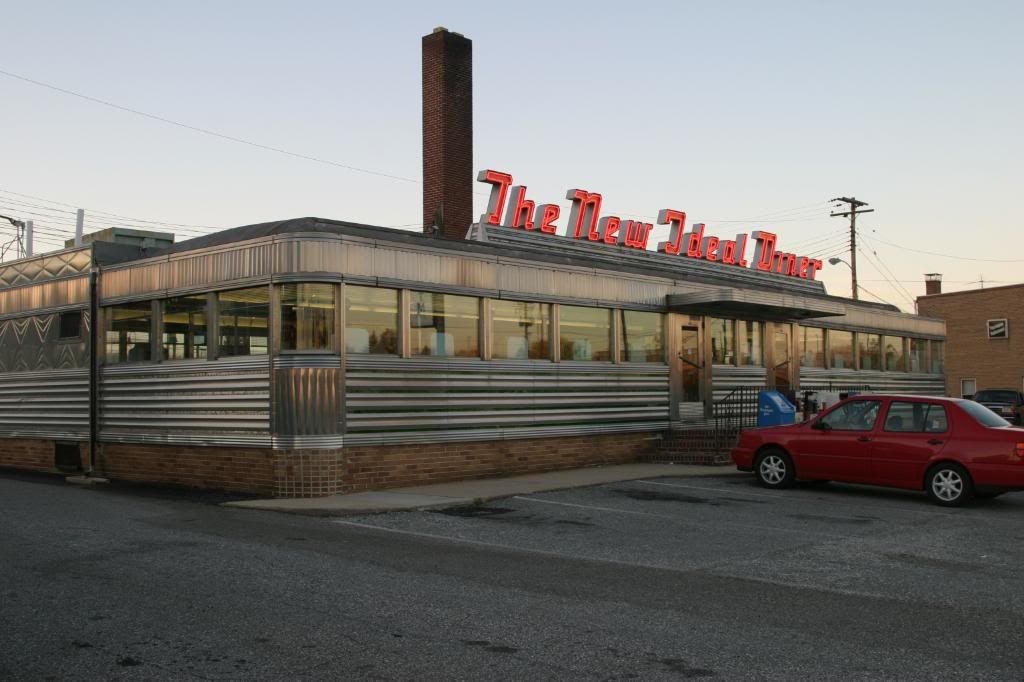
The New Ideal Diner in Aberdeen, Maryland, located on Route 40, a broad four lane highway that connects Baltimore with the New Jersey Turnpike, is a good example. Sparkling and clean, its counter and comfortable booths can accommodate 102. Its menu caters to a wide range of eating tastes.

On the average day, you will find chauffeured limousines sharing its parking space with jeeps, hot rods and station wagons. You might even bump into Maryland’s Governor Theodore McKeldin, Jr. It is one of his favorite stopping-off places when he is traveling on the road.

The New Ideal’s owners, Steve Karas, Jr., and his uncle, Pete Mikes, paid O’Mahony’s $105,000 for it ($852,000 in 2009 dollars). They could have spent as little as $30,000 for a smaller unit, or as much as $150,000 for a larger one.

Each diner is more or less tailored to meet the purchaser’s needs. They can be bought stripped down except for essentials, or complete even to juke boxes, cigarette machines and toothpicks. The cost, naturally, varies accordingly.

Diners generally are not kept “in stock” as some impatient would-be owners expect. One day a little old man entered the showroom of Jerry O’Mahony, Inc., located in Elizabeth, N.J. O’Mahony, together with the Kullman Dining Car Company, Silk City Diner, Inc., and a half dozen others, builds the greatest number of the modern dog wagons sold.

The man carried a black bag and announced to O’Mahony’s president, L.F. Camardella, that he wanted to buy a diner. When Mr. Camardella began showing him typical plans, the old-time became impatient, picked up his bag and dumped it on the desk. Bundles of tightly rolled bills tumbled out.

“There’s $50,000 in cash,” the customer announced. “Now show me a diner. I want it this week.”

The money was the old fellow’s life savings, and one of the saddest moments in his life was when it was explained that he would have to wait at least 15 weeks while a “car” was built to his specifications. A certain amount of custom building is necessary in order to give each owner just what he wants.

Within the space of a few weeks recently, the boys at Jerry O’Mahony’s were confronted with these special design requests: one buyer wanted a mahogany paneled private office, complete with foldaway bed and built in sun lamp and TV set; another ordered tropical fish tanks installed in the glass-brick walls of the dining area; a third specified six counter stools fitted up to look like hobby horses, as entertainment for small fry.

Not long ago a former member of the State Department found time hanging heavy on his hands so he began shopping around for something to do. A friend suggested the diner business. He checked the possibilities and now runs a profitable “plush” diner at a busy crossroads in New York’s Westchester County.

He is having a grand time feeding hamburgers and table d’hote lunches to women shoppers and dinners to families of the community. And at night he features an outsize menu that includes gastronomical delights such as lobster, steaks and baked Alaska.

Photobucket
Photobucket
Photobucket
Photobucket

Mahony Diners, Inc.

Photobucket

Photobucket
Anthony Damiano
Sheet Metal Foreman
11 years

Photobucket
Joseph Montano
President- Plant Manager, Sales
12 years

Photobucket
John L. Cronk
Vice President and General Sales Manager
6 years

Photobucket
Joseph Cavallo
Secretary Treasurer
5 years

Photobucket
John Mayers
Carpenter Foreman
29 years

Photobucket
Ray Anisko
Design Draftsman
12 years

Photobucket
Pete Nalio
Carpenter
5 years

Photobucket
George Gibbons
Machine Operator
30 years

Photobucket
Frank Bonifanti
Structural steel foreman
11 years

Photobucket
John Hospodar
Sheet Metal Man
15 years

Photobucket
George Campbell
Sheet Metal Man
12 years
———————–

Mahony’s Experience Assures your success
– the one fine diner- modern diner construction
-profit planned placement of food service equipment
-complete engineering service
-Premium Construction and equipment throughout for more years of cost-free service
-Down to earth financing and budget planning
-carefully surveyed and analyzed locations
————————
Our experienced staff of diner specialists welcome the chance to advise you on your special problems and needs

Mahony Diners, Inc.
60 Jacobus Ave
South Kearney, NJ

MArket 2-0033

Photobucket

A surviving Mahony Diner.
Matchbook from the Mahony Company

White Diamond Hamburgers- Linden, NJ

Photobucket

Photobucket

Photobucket
sign- white diamond. font is reminiscent of white castle

Photobucket
side

Photobucket
Blue Tower enamel signs were painted over when it changed names. The paint is fading/ peeling now.

Photobucket
Centrally located grill- I’ve never seen another diner in person with this setup.

Photobucket
Blue, white, and metal

Photobucket
View through grill vent window.

Photobucket

DiNic’s- Ex White Tower- NJ/WV

This New Jersey White Tower was one of the rare ones built by the Valentine Diner company. Under threat of destruction, it was moved to West Virginia by John Shoaf.

Photobucket

Photobucket

Photobucket

Next door was the beautiful Harwan Movie theater, which as I understand it, is no more.

Photobucket

Photobucket

Photobucket

Photobucket