Tierney Diner Ad – 1926

Photobucket

No matter what your present occupation, or where you are located- if you have been seeking YOUR opportunity; if you have been anxious to get into business for yourself- to be your own Boss- or if you are in business and dissatisfied with its results; if you want to make more money than you ever made in your life- if you are willing to work and win success- then a Tierney diner is YOUR opportunity. It’s a clean, respectable PROFITABLE business for YOU- Every day in the year!

You would be one of the most independent men in your community. Your money would be turned over quickly. 30% – 40% of each days receipts would be your NET profit! You would have a strictly cash business. No bad accounts. No collections to make

The Dining Car business is spreading fast. Men like yourself, and with no more experience at the start, are getting rich in it. You can do it, too!

* * *

A Total capital of $3000 ($36,000 in 2009 $) – will set you up in this business- provide the first payment on your car and leave enough to install it on location, open it up and start your daily receipts coming in- and many successful operators have done it on less.

* * *

YOU CAN START
The Dining Car Business in your own town.

The Tierney Real Estate Department checks up your location, or obtains one for you, thus assuring a proper business building location for your car.

We train you for success, just as we have trained hundreds of other operators of Tierney Diners.

You can take advantage of our Training School, if you desire.

Tierney service helps you in all details of operation, providing reliable and experienced chefs, and other employees, if desired, and supervises and guides your management, if needed, until you are sufficiently experienced to assure success by yourself.

no Tierney Dining Car located and operated in accordance with Tierney Service and Instruction need ever fail, for when you purchase a Tierney Diner you get back of you thirty years of successful experience in this business.

* * *

Tierney Service makes Monthly Payment Plan possible. The Lunch Car business is essentially a worker’s business. It has not been built up by capitalists, although it has created capital for its operators- but has won out through the energy and close attention to business of men who with a small amount of money to start with have followed up that moderate capital with an unlimited supply of conscientious, faithful work. That is what makes the Lunch Car business such a sound, dependable business to be engaged in; it is built on foundations of individual industry and common honesty.

“Fully ninety-five per cent of the hundreds who have won success and independence in this business have started with very little money, so the plan had to be devised to help these men get there cars as well as stand by them until they had made a success of the business. In other words, after you have made your first payment down, the car will pay the balance.”

* * *

Wherever you see a Tierney dining car you will find a man who is making money.

* * *

This portable restaurant is delivered on its own wheels to its permanent location, where connections are made for water, sewer, gas or electricity.

* * *

Just the Way they look inside: Tiled floors and walls, stool porcelain, oak tops with nickel rim, counters marble or black walnut. Back of counter complete kitchen, tiled ice box, equipped with most modern type of range, short order stove; steam table, nickeled coffee urns, hot water heater. The last word in brightness and cleanliness.

* * *

If YOU owned a Tierney Dining Car like this, $5000 to $10000 should be your YEARLY PROFITS

Photobucket

Photobucket

Photobucket

Photobucket

The Roadside Diners Are Rolling

From September 1953’s CORONET

Photobucket

by George H. Waltz Jr.

This strictly American phenomenon has come a long ways since its inception in 1882.

TWO YEARS AGO, Danny Long was a promising young catcher in the Montreal Royals when a play at home plate resulted in a bad shoulder injury. It was a grim day for Danny when the doctors gave him the bad news that his baseball days were probably over.

While nursing his physical ills and wondering how he was going to earn a living, he met the owner of a diner in Trenton, New Jersey.

Lacking anything better to do, he began helping the counter whenever he could. That did it. A quick trip back to his home town of Montgomery, Alabama, proved two things. Montgomery did not have a modern diner, and Montgomery businessman was willing to lend Danny a hand financially.

Back North, Danny ordered a diner. While it was taking shape in a New Jersey factory- a process that usually takes about four months- he went about getting experience by taking odd jobs in various diners in the vicinity. When off duty, he hung around the factory and watched a diner grow from plans on a drawing board to completion.

“Danny’s Diner” now packs them in at the corner of Bainbridge and Madison Avenues in downtown Montgomery. Among other things, it has the distinction of being the first modern restaurant-type diner to begin operations in Alabama.

Currently, the gleaming modern version of the old time “dog-wagon” – air-conditioned, well lighted, spotlessly clean, and with a menu as long as your arm- has taken a place of honor in the community. Businessmen go there for lunch. The church choir gathers there after rehersals. Local organizations hold their meetings there. Teenagers use it as a club. The diner is the hottest thing in the eatery business. So much so, in fact, that many a restaurant has put up a false diner-front in the hope of getting in on the act.

And a lucrative act it is. According to those who should know, hungry patrons this year will pour about $600,000,000 (4.7 Billion in 2009 dollars) into the tills of the nearly 6,000 diners operating in the nation. As a result, more than one operator will ring up better than $500,000 in 1953 ($4 million in 2009 dollars) , and be able to pocket a neat profit of $1000 a week for himself after deducting expenses and taxes.

The tax problem itself is eased by the fact that the modern diner is pre-built, fabricated in a factory, put on a trailer and towed to its site, from which it can just as easily be jacked up again, put back on wheels and towed to another spot if the owner desires.

Thus, the diner is “personal property,” like the automobile, and can be written off at ten per cent a year for the first ten years for depreciation. And real estate tax assessments are likely to be lower than those on a stationary restaurant.

Lack of experience seems to be no serious drawback. As one diner man put it recently, “Experience is a help but not a ‘must’ in this game. Any guy with a flair for business can make money.” And the records bear him out – the failures are few.

* * *

Sentimental reasons put one couple into the diner business. They met a few years ago when they accidentally locked bumpers in the parking space behind a diner on New York’s Route 9. She was a cashier in the diner, he an Army mess-sergeant on leave.

After that, whenever he was home, he spent most of his time at the diner where he got bitten by the “diner bug” as well as the “love bug.” Finally, when he got out of the Army, both bugs took, with the result that today this married couple own their own diner. Like most operators, they bought it on time- paying a quarter down and the rest in 36 monthly payments – and they are having little trouble meeting the installments.

Oddly enough, if you are to believe the statistics, they are more likely to be successful with their diner than they are with their marriage. Divorce rates are high, but the company that sold them their diner on time hasn’t repossessed one since the Depression in the 30s! The manufacturers, Jerry O’Mahony, Inc., world’s largest maker of diners, won’t sell a diner until a thorough check of traffic and neighborhood needs at the proposed site has convinced them it will pay off.

What is the secret of the modern diner’s success?

In the first place, the dog wagon is as strictly American an enterprise as the hot dog that made it famous. An enterprising young man in Worcester, Massachusetts – Sam Jones – is credited with putting the diner on its road to success in 1882. Sam’s diner was a horse -drawn wagon with a window cut in its side, through which Sam peddled hot dogs, sandwiches and coffee to factory hands as he traveled from mill to mill in Worcester.

When Jones found that winter weather reduced business, he closed the window, cut in a door, and put up a small counter with stools so his customers could come in out of the cold. Sam built up a regular daytime route and his dog wagon business thrived.

By the turn of the century, diners – larger and more elaborate versions of Jones’ horse-drawn wagon were being turned out in Worcester by Charlie Buckley (Thomas H Buckley?) , ardently supported by Prohibitionists who saw in his touring white and gold dog wagons a potential answer to the corner saloon – a place serving good, inexpensive food without offering the temptation of liquor.

When electric cars began replacing horsecars on city streets, sharp businessmen with eyes for quick profits bought up the outmoded horsecars and set them up in out of the way neighborhoods as quick lunch spots. Then, diner operators turned manufacturers began producing diners built just for that purpose.

However, it wasn’t until the mid ’20’s that the diner people decided to push back their wooden counters to make room for booths. At that time, women – “flappers” in particular – began to patronize the dog wagons. But it wasn’t until right before World War II that the modern restaurant-type diner began to make its appearance, first on the roadsides and then in the larger cities and towns.

THE MODERN DINER – “cars” they are called in the trade – is popular because it is flexible. Operating 24 hours a day, it is geared to cater to the tourist in a sports shirt, the family trade, as well as the party-goer in black tie. Its menu includes full-course dinners as well as the old dog wagon stand-bys. The customer who stops by for a fast cup of coffee feels as welcome as the man who wants a leisurely steak. It is everybody’s place regardless of dress, time available or apetite.

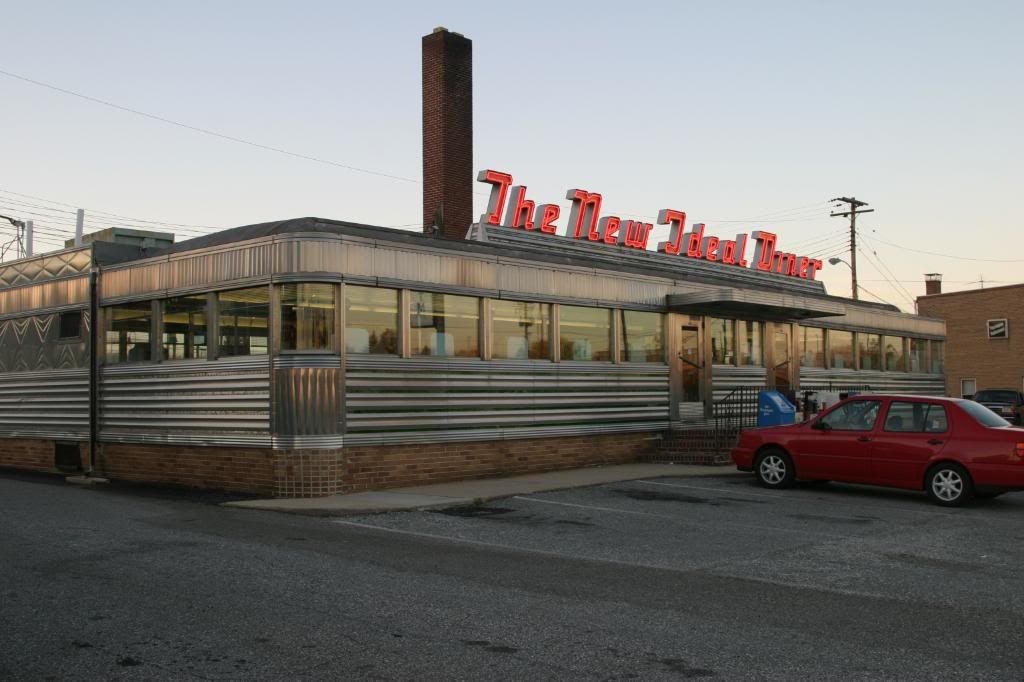
The New Ideal Diner in Aberdeen, Maryland, located on Route 40, a broad four lane highway that connects Baltimore with the New Jersey Turnpike, is a good example. Sparkling and clean, its counter and comfortable booths can accommodate 102. Its menu caters to a wide range of eating tastes.

On the average day, you will find chauffeured limousines sharing its parking space with jeeps, hot rods and station wagons. You might even bump into Maryland’s Governor Theodore McKeldin, Jr. It is one of his favorite stopping-off places when he is traveling on the road.

The New Ideal’s owners, Steve Karas, Jr., and his uncle, Pete Mikes, paid O’Mahony’s $105,000 for it ($852,000 in 2009 dollars). They could have spent as little as $30,000 for a smaller unit, or as much as $150,000 for a larger one.

Each diner is more or less tailored to meet the purchaser’s needs. They can be bought stripped down except for essentials, or complete even to juke boxes, cigarette machines and toothpicks. The cost, naturally, varies accordingly.

Diners generally are not kept “in stock” as some impatient would-be owners expect. One day a little old man entered the showroom of Jerry O’Mahony, Inc., located in Elizabeth, N.J. O’Mahony, together with the Kullman Dining Car Company, Silk City Diner, Inc., and a half dozen others, builds the greatest number of the modern dog wagons sold.

The man carried a black bag and announced to O’Mahony’s president, L.F. Camardella, that he wanted to buy a diner. When Mr. Camardella began showing him typical plans, the old-time became impatient, picked up his bag and dumped it on the desk. Bundles of tightly rolled bills tumbled out.

“There’s $50,000 in cash,” the customer announced. “Now show me a diner. I want it this week.”

The money was the old fellow’s life savings, and one of the saddest moments in his life was when it was explained that he would have to wait at least 15 weeks while a “car” was built to his specifications. A certain amount of custom building is necessary in order to give each owner just what he wants.

Within the space of a few weeks recently, the boys at Jerry O’Mahony’s were confronted with these special design requests: one buyer wanted a mahogany paneled private office, complete with foldaway bed and built in sun lamp and TV set; another ordered tropical fish tanks installed in the glass-brick walls of the dining area; a third specified six counter stools fitted up to look like hobby horses, as entertainment for small fry.

Not long ago a former member of the State Department found time hanging heavy on his hands so he began shopping around for something to do. A friend suggested the diner business. He checked the possibilities and now runs a profitable “plush” diner at a busy crossroads in New York’s Westchester County.

He is having a grand time feeding hamburgers and table d’hote lunches to women shoppers and dinners to families of the community. And at night he features an outsize menu that includes gastronomical delights such as lobster, steaks and baked Alaska.

Photobucket
Photobucket
Photobucket
Photobucket

Mahony Diners, Inc.

Photobucket

Photobucket
Anthony Damiano
Sheet Metal Foreman
11 years

Photobucket
Joseph Montano
President- Plant Manager, Sales
12 years

Photobucket
John L. Cronk
Vice President and General Sales Manager
6 years

Photobucket
Joseph Cavallo
Secretary Treasurer
5 years

Photobucket
John Mayers
Carpenter Foreman
29 years

Photobucket
Ray Anisko
Design Draftsman
12 years

Photobucket
Pete Nalio
Carpenter
5 years

Photobucket
George Gibbons
Machine Operator
30 years

Photobucket
Frank Bonifanti
Structural steel foreman
11 years

Photobucket
John Hospodar
Sheet Metal Man
15 years

Photobucket
George Campbell
Sheet Metal Man
12 years
———————–

Mahony’s Experience Assures your success
– the one fine diner- modern diner construction
-profit planned placement of food service equipment
-complete engineering service
-Premium Construction and equipment throughout for more years of cost-free service
-Down to earth financing and budget planning
-carefully surveyed and analyzed locations
————————
Our experienced staff of diner specialists welcome the chance to advise you on your special problems and needs

Mahony Diners, Inc.
60 Jacobus Ave
South Kearney, NJ

MArket 2-0033

Photobucket

A surviving Mahony Diner.
Matchbook from the Mahony Company

White Diamond Hamburgers- Linden, NJ

Photobucket

Photobucket

Photobucket
sign- white diamond. font is reminiscent of white castle

Photobucket
side

Photobucket
Blue Tower enamel signs were painted over when it changed names. The paint is fading/ peeling now.

Photobucket
Centrally located grill- I’ve never seen another diner in person with this setup.

Photobucket
Blue, white, and metal

Photobucket
View through grill vent window.

Photobucket

DiNic’s- Ex White Tower- NJ/WV

This New Jersey White Tower was one of the rare ones built by the Valentine Diner company. Under threat of destruction, it was moved to West Virginia by John Shoaf.

Photobucket

Photobucket

Photobucket

Next door was the beautiful Harwan Movie theater, which as I understand it, is no more.

Photobucket

Photobucket

Photobucket

Photobucket

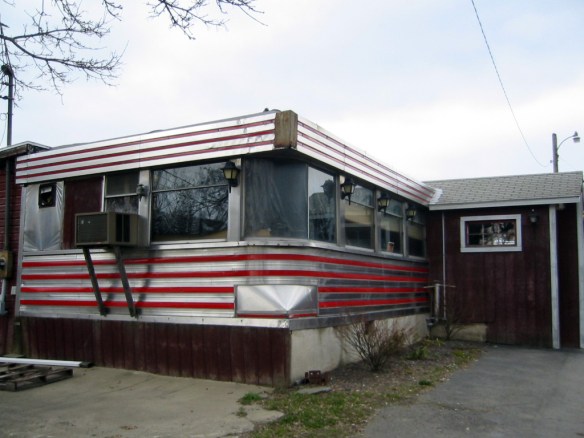
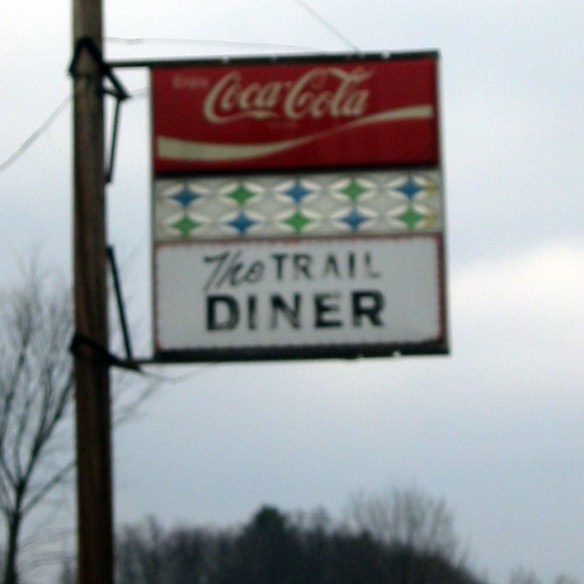
The Trail Diner- New Milford PA

I took these photos Trail Diner, Rt 11, New Milford, PA. back in 2004. It’s a c.1948 Mountain View. At that point it was pretty beat up with wood repairs done to the stainless and what appeared to be garbage bags covering the windows. I believe it was out of business at that point, though there were cars in the parking lot. As of 2013, it was looking about 9 years the worse for wear.

183-8341_IMG183-8342_IMG183-8343_IMG

19936 US 11 Google Maps


Coventry Diner

Here’s a photo taken several years ago of Pennsylvania’s Coventry Diner, a later Silk City which has undergone remodeling.

Photobucket
The four windows on the right are part of an addition. From that part left is the original diner.

Photobucket

Worcester’s Mac’s Diner Burns

Mac’s Diner Burns – Article in the Telegram

Photobucket

By Scott J. Croteau TELEGRAM & GAZETTE STAFF
scroteau@telegram.com

WORCESTER — For the half-dozen times a month Bob Hebb heads into Worcester from his hometown of Ayer, he makes sure to head over to Shrewsbury Street.

His destination is Mac’s Diner, where a large kettle of soup usually beckons and the stools are filled with patrons he knows by name.

But yesterday, Mr. Hebb arrived at his favorite restaurant only to learn that an overnight fire had damaged and closed the business.

The owners of the restaurant — which dates to 1931 — are unsure when they’ll reopen.

“You have never eaten in here? They have a kettle of soup that is about this high,” Mr. Hebb said, holding his hands a couple of feet apart. “I don’t know where I’m going to eat.”

As Mr. Hebb was left wondering where he’d get his usual soup and a sausage sandwich — made on the diner’s homemade bread — a crew of city Department of Public Works and Parks workers headed to the entrance at 185 Shrewsbury St.

Mr. Hebb soon informed them of the situation: “It’s closed. There was a fire.”

About noon yesterday, owner Chris McMahon of Holden walked around inside the diner and assessed the damage. Mac’s is said to be the oldest diner in the city.

He doesn’t know when it will reopen.

“I couldn’t even guess. I’m at the mercy of the Fire and Building departments,” he said. “Hopefully not that long. I have to make a living.”

The fire started about 12:30 a.m. in a storage area in the rear of the building, where there are freezers and refrigerators.

Mr. McMahon said the cause of the fire appears to be electrical but fire officials have not yet determined the cause.

Firefighters broke through a front window and doused the flames with water.

The upper diner area was damaged as well as a side area. The acrid smell of burnt wood replaced the normal smell of home-cooked meals yesterday afternoon.

The damage could have been worse, but the diner’s concrete and brick walls didn’t give the fire much to feed on. Holden police knocked on Mr. McMahon’s door early yesterday morning to notify him about the fire.

He raced down to Shrewsbury Street.

“When I first showed up here, I was in total shock,” he said. “I have come to assess it. It’s manageable, but it is definitely going to set us back.”

“In 78 years, we’ve never had a fire here,” Mr. McMahon, 31, said.

“We plan to fix it as soon as we can because we are all going to be out of money.”

Customers continually called the diner yesterday asking if the owners needed help and to say they were sorry. The diner is normally open Monday through Friday for lunch, with dinner also served Thursday through Saturday.

Many customers favor Mac’s because of its BYOB standing.

“April, May and June are our busy season,” Mr. McMahon said.

“It’s not a good financial time, and our employees are also out of work. We’re missing out on our money time.”

Mac’s Diner is/was a 1931 Worcester Diner.

Photobucket

Red Rose Diner

The Red Rose Diner Reopens!

Red Rose Diner in Towanda Borough under new ownership

BY JAMES LOEWENSTEIN
STAFF WRITER
Published: Thursday, April 2, 2009 3:16 AM EDT
TOWANDA — The Red Rose Diner, now a Towanda landmark, is under new ownership.

Michael Holt and Bill O’Shea, both from Buck County, bought the 82-year-old diner on Feb. 18, and they held a grand re-opening of the eatery on Wednesday, Holt said.

Holt said he has expanded the hours of the diner so that it stays open until the early evening on Wednesdays through Saturdays, and plans to add items to the menu.

“We’ll put a flower garden and flower boxes around the building,” he said.

*
Holt is a self-described “diner fanatic” who says he spent years looking for an historic diner to buy and operate, before he decided to buy the Red Rose Diner. He said that he visited approximately 50 diners in his quest to find the right one.

He had read about the Red Rose Diner in books on diners, but did not know it was for sale when he visited it for the first time last summer.

He said he was extremely impressed with what he saw.

“I would have offered to buy it,” Holt said. “I liked it that much. (But) it turned out it was for sale (anyway).”

Holt said he and O’Shea will keep the name “Red Rose Diner,” and have no plans to move the diner from Towanda.

“I love that it’s on Route 6,” he said. “We were fortunate enough to find that it’s in a really special town. We’ll never move it.”

Betty Roof will continue to work at the diner, and she will be doing most of the cooking, Holt said.

“Most of the original features of the diner are still here,” including the stools, marble tabletops and counter tops, mosaic tile floor, stained glass windows, the tile and oak on the interior walls, grill, refrigerator and telephone, Holt said. “It’s an absolute gem in that respect.”

The previous owner, Gordon Tindall, had bought the diner in 1998 and restored it in Lancaster County. Tindall then moved the diner to Towanda, where it opened for business several years ago.

Holt said that last summer, he had talked to George Metropoulos Jr., the 92-year-old son of the original owner of the diner, who had seen the diner after it was restored.

Metropoulos, who used to work at the diner himself, said “the diner looked exactly the way he remembered it,” according to Holt.

Holt said he is applying to have the Red Rose Diner listed on the National Register of Historic Places, partly because of its role in expanding diners to accommodate women.

According to a written statement on the diner’s menu, “it was the first model designed to entice women (to come to the diner). The little tables were added for the ladies and stained glass windows afforded female customers privacy from oglers out on the sidewalk.”

Holt said he has an interest in things that are historic. He said he served on the board of directors of Peddler’s Village in Bucks County, which is “like a little Colonial Williamsburg,” including restored buildings and buildings that were constructed to look historic.

“I’ve always been in the hospitality and restaurant business,” said Holt, who now lives in Towanda.

The Red Rose Diner is located at 526 Main St. in Towanda.

James Loewenstein can be reached at (570) 265-1633; or e-mail: jloewenstein@thedailyreview.com.

Photobucket

Photobucket

Photobucket

Photobucket

Photobucket

Photobucket