Diner Slides- 1976-1988

Some more from the archives, in no particular order.

Short Stop Diner, now Irene’s pupusas. Wheaton, MD
It’s a 1956 Kullman. The neon was nearly as big as the diner itself, but has since disappeared.

Then:
Photobucket

Photobucket

Now:
Photobucket

Diner- Front Royal, VA
It’s a 1956 Mountain View. Front Royal used to be a hotbed of diners. It had this one, Nick’s Good Food diner, the Do-nut dinette, and another ’50s stainless model. The other three have been knocked down, and this one’s now a used car dealer.

Photobucket

Photobucket

Photobucket

Now:

Photobucket

Photobucket

Frost Diner- Warrenton, VA
The Frost is a 1955 O’Mahony.

Photobucket

Inside
Photobucket

Counter
Photobucket

A sign of the times- Disco Fashion T-shirts
Photobucket

Pork Chop- $1.25, Fried Chicken $1.75
Photobucket

Photobucket

Tastee Diner- Silver Spring, MD

Photobucket

Photobucket

Tastee Diner- Laurel, MD
a rare Comac brand diner

Photobucket

Bud’s Broiler – New Orleans, LA
Bud’s Broiler
Photobucket

Allen Theater
Current Photos
Photobucket

Flower Theater
Current Photos
Photobucket

Summit Diner– Somerset, PA
Summit Diner
Photobucket

Moody’s Diner- Waldoboro, ME
Moody’s Diner
Photobucket

Diner- MA
Photobucket

Letterman’s Diner- Kutztown, PA

We stopped here this morning for a second breakfast, a “short” stack of pancakes and a side of bacon for me, an order of eggs, bacon, homefries for my dad. My short stack turned out to be two excellent pancakes the size of platters, which even I couldn’t finish. The bacon was tasty, the coffee fresh, and the grillmanship exciting.

Outside view of the diner. Though an angled front facade has been added, the complete barrel roof is still visible. You can see where the original front sliding door once was.

Photobucket

Photobucket

Photobucket

Inside view of the diner. Lots of later changes, but the tile work on the counter, the ceiling and the vent hood are original.

Photobucket

It looks from this period photo, taken after the move, that a white painted flat ceiling was added, preserving the original wood barrel roofed ceiling underneath.
Photobucket

Original window at the front of the diner. The other window has been removed to make way for a larger front door.

Photobucket

The ceiling of the diner has this design painted where the seam trim of the ceiling (now missing) meet.
Photobucket

Dan’s Diner of Spencertown, NY- same design.
Photobucket

Vent hood
Photobucket

Photobucket

Photobucket

Photobucket

The owners of the diner say that this is the nation’s oldest Silk City, built in the very early 1930s. Can anyone confirm Silk City as the builder?

Manufacturer of the diner has been confirmed as a O’Mahony.

Compare to this interior photo of Dan’s Diner of Spencertown, NY. Same vent hood, same sliding door (though the Kutztown one’s is gone, it’s visible in the old photos, and the doublewide delete on the wall), and the same ornamentation on the ceiling
Photobucket


Letterman’s Diner @ Dine Indie

Letterman’s Diner MySpace

DC / MD diner trip – May 24, 2009

This was my first real diner trip in a while. I met up today with Mike Engle, author of Diners of New York; the man behind NYdiners.com, and roadside buff and frequent Zippy the Pinhead contributor Ed Engel at the American City Diner, and headed out from there.

The first stop of the day was the American City Diner of 5532 Connecticut Ave NW Washington, DC. It’s a late ’80s Kullman, one of the early retro-styled diners, and one of the ones that did it right. For some photos as it appeared when new, click here. Since then, it’s been added on to, with a large side addition, and a front porch which obscures everything to the left of the vestibule.
Photobucket

The Left side of the diner- 2009
Photobucket
The left side of the diner – 1989
Photobucket

The former Howard Theater. Great rusty marquis on this one.
Photobucket

Photobucket

The now abandoned Wonderbread / Hostess Factory

Photobucket

Photobucket

Ran into a little excitement along the way between these two stops, but all’s well that ends well.

Northeast Academy of Dance Neon sign. Look at the detail at the left hand corner of the sign.
Photobucket

We hit up the Capital City Diner, which was moved here on the 20th. Watch the video of it being moved. This Silk City, formerly of Avoca New York, has made its way to the Trinidad neighborhood of Northeast DC.
Photos at its original location and some backstory can be found at :A Real Historic Diner Coming to DC!

Photobucket

Photobucket

This next leg of the trip had some neat neon and signage

A&R Auto Parts
Photobucket

Syd’s Drive In / Liquor
Photobucket

Cross Roads
Photobucket

Tesst theater
Photobucket

Hyattsville Hardware / Franklin’s
Photobucket

Calvert House
Photobucket

Silver Spring’s old Canada Dry bottling plant
Photobucket

A quick stop at the Silver Spring Tastee was made.

Now
Photobucket

Then
Photobucket
More old photos can be found here.

Then a side trip to Forest Glen, parts of which have deteriorated greatly since my last visit.
Photobucket

Photobucket

Photobucket

Dinner at the Tastee Diner in Bethesda
Photobucket

Then
Photobucket

And the trip’s final stop at Bethesda’s former Little Tavern. A 1990 photo of it, when it was still a Little Tavern, can be found on the Diner Hotline.

Photobucket

Photobucket

The Roadside Diners Are Rolling

From September 1953’s CORONET

Photobucket

by George H. Waltz Jr.

This strictly American phenomenon has come a long ways since its inception in 1882.

TWO YEARS AGO, Danny Long was a promising young catcher in the Montreal Royals when a play at home plate resulted in a bad shoulder injury. It was a grim day for Danny when the doctors gave him the bad news that his baseball days were probably over.

While nursing his physical ills and wondering how he was going to earn a living, he met the owner of a diner in Trenton, New Jersey.

Lacking anything better to do, he began helping the counter whenever he could. That did it. A quick trip back to his home town of Montgomery, Alabama, proved two things. Montgomery did not have a modern diner, and Montgomery businessman was willing to lend Danny a hand financially.

Back North, Danny ordered a diner. While it was taking shape in a New Jersey factory- a process that usually takes about four months- he went about getting experience by taking odd jobs in various diners in the vicinity. When off duty, he hung around the factory and watched a diner grow from plans on a drawing board to completion.

“Danny’s Diner” now packs them in at the corner of Bainbridge and Madison Avenues in downtown Montgomery. Among other things, it has the distinction of being the first modern restaurant-type diner to begin operations in Alabama.

Currently, the gleaming modern version of the old time “dog-wagon” – air-conditioned, well lighted, spotlessly clean, and with a menu as long as your arm- has taken a place of honor in the community. Businessmen go there for lunch. The church choir gathers there after rehersals. Local organizations hold their meetings there. Teenagers use it as a club. The diner is the hottest thing in the eatery business. So much so, in fact, that many a restaurant has put up a false diner-front in the hope of getting in on the act.

And a lucrative act it is. According to those who should know, hungry patrons this year will pour about $600,000,000 (4.7 Billion in 2009 dollars) into the tills of the nearly 6,000 diners operating in the nation. As a result, more than one operator will ring up better than $500,000 in 1953 ($4 million in 2009 dollars) , and be able to pocket a neat profit of $1000 a week for himself after deducting expenses and taxes.

The tax problem itself is eased by the fact that the modern diner is pre-built, fabricated in a factory, put on a trailer and towed to its site, from which it can just as easily be jacked up again, put back on wheels and towed to another spot if the owner desires.

Thus, the diner is “personal property,” like the automobile, and can be written off at ten per cent a year for the first ten years for depreciation. And real estate tax assessments are likely to be lower than those on a stationary restaurant.

Lack of experience seems to be no serious drawback. As one diner man put it recently, “Experience is a help but not a ‘must’ in this game. Any guy with a flair for business can make money.” And the records bear him out – the failures are few.

* * *

Sentimental reasons put one couple into the diner business. They met a few years ago when they accidentally locked bumpers in the parking space behind a diner on New York’s Route 9. She was a cashier in the diner, he an Army mess-sergeant on leave.

After that, whenever he was home, he spent most of his time at the diner where he got bitten by the “diner bug” as well as the “love bug.” Finally, when he got out of the Army, both bugs took, with the result that today this married couple own their own diner. Like most operators, they bought it on time- paying a quarter down and the rest in 36 monthly payments – and they are having little trouble meeting the installments.

Oddly enough, if you are to believe the statistics, they are more likely to be successful with their diner than they are with their marriage. Divorce rates are high, but the company that sold them their diner on time hasn’t repossessed one since the Depression in the 30s! The manufacturers, Jerry O’Mahony, Inc., world’s largest maker of diners, won’t sell a diner until a thorough check of traffic and neighborhood needs at the proposed site has convinced them it will pay off.

What is the secret of the modern diner’s success?

In the first place, the dog wagon is as strictly American an enterprise as the hot dog that made it famous. An enterprising young man in Worcester, Massachusetts – Sam Jones – is credited with putting the diner on its road to success in 1882. Sam’s diner was a horse -drawn wagon with a window cut in its side, through which Sam peddled hot dogs, sandwiches and coffee to factory hands as he traveled from mill to mill in Worcester.

When Jones found that winter weather reduced business, he closed the window, cut in a door, and put up a small counter with stools so his customers could come in out of the cold. Sam built up a regular daytime route and his dog wagon business thrived.

By the turn of the century, diners – larger and more elaborate versions of Jones’ horse-drawn wagon were being turned out in Worcester by Charlie Buckley (Thomas H Buckley?) , ardently supported by Prohibitionists who saw in his touring white and gold dog wagons a potential answer to the corner saloon – a place serving good, inexpensive food without offering the temptation of liquor.

When electric cars began replacing horsecars on city streets, sharp businessmen with eyes for quick profits bought up the outmoded horsecars and set them up in out of the way neighborhoods as quick lunch spots. Then, diner operators turned manufacturers began producing diners built just for that purpose.

However, it wasn’t until the mid ’20’s that the diner people decided to push back their wooden counters to make room for booths. At that time, women – “flappers” in particular – began to patronize the dog wagons. But it wasn’t until right before World War II that the modern restaurant-type diner began to make its appearance, first on the roadsides and then in the larger cities and towns.

THE MODERN DINER – “cars” they are called in the trade – is popular because it is flexible. Operating 24 hours a day, it is geared to cater to the tourist in a sports shirt, the family trade, as well as the party-goer in black tie. Its menu includes full-course dinners as well as the old dog wagon stand-bys. The customer who stops by for a fast cup of coffee feels as welcome as the man who wants a leisurely steak. It is everybody’s place regardless of dress, time available or apetite.

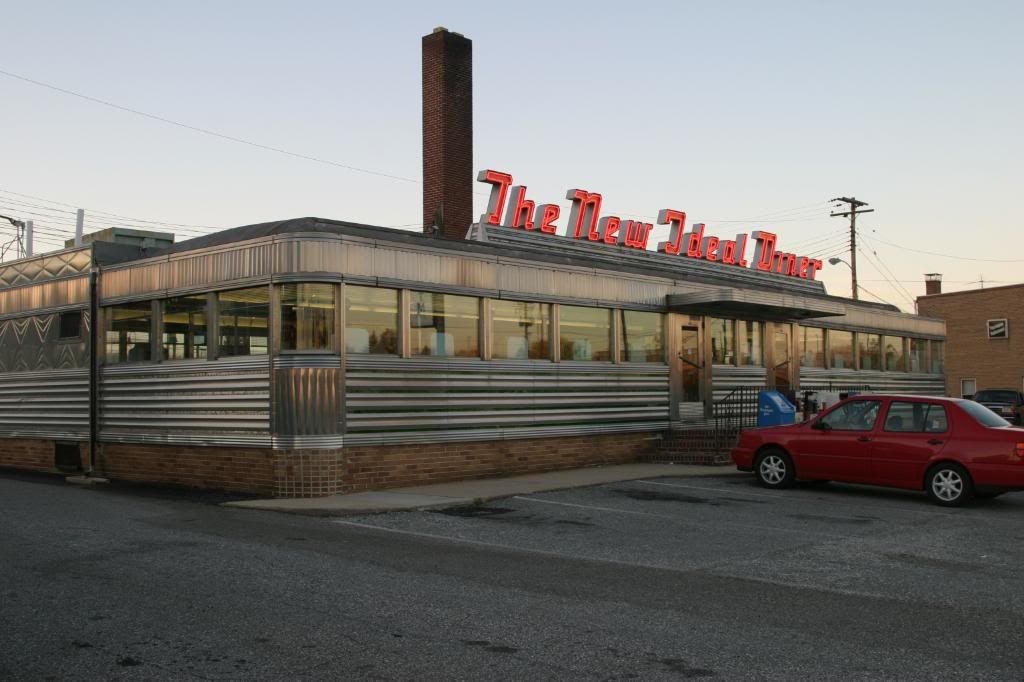
The New Ideal Diner in Aberdeen, Maryland, located on Route 40, a broad four lane highway that connects Baltimore with the New Jersey Turnpike, is a good example. Sparkling and clean, its counter and comfortable booths can accommodate 102. Its menu caters to a wide range of eating tastes.

On the average day, you will find chauffeured limousines sharing its parking space with jeeps, hot rods and station wagons. You might even bump into Maryland’s Governor Theodore McKeldin, Jr. It is one of his favorite stopping-off places when he is traveling on the road.

The New Ideal’s owners, Steve Karas, Jr., and his uncle, Pete Mikes, paid O’Mahony’s $105,000 for it ($852,000 in 2009 dollars). They could have spent as little as $30,000 for a smaller unit, or as much as $150,000 for a larger one.

Each diner is more or less tailored to meet the purchaser’s needs. They can be bought stripped down except for essentials, or complete even to juke boxes, cigarette machines and toothpicks. The cost, naturally, varies accordingly.

Diners generally are not kept “in stock” as some impatient would-be owners expect. One day a little old man entered the showroom of Jerry O’Mahony, Inc., located in Elizabeth, N.J. O’Mahony, together with the Kullman Dining Car Company, Silk City Diner, Inc., and a half dozen others, builds the greatest number of the modern dog wagons sold.

The man carried a black bag and announced to O’Mahony’s president, L.F. Camardella, that he wanted to buy a diner. When Mr. Camardella began showing him typical plans, the old-time became impatient, picked up his bag and dumped it on the desk. Bundles of tightly rolled bills tumbled out.

“There’s $50,000 in cash,” the customer announced. “Now show me a diner. I want it this week.”

The money was the old fellow’s life savings, and one of the saddest moments in his life was when it was explained that he would have to wait at least 15 weeks while a “car” was built to his specifications. A certain amount of custom building is necessary in order to give each owner just what he wants.

Within the space of a few weeks recently, the boys at Jerry O’Mahony’s were confronted with these special design requests: one buyer wanted a mahogany paneled private office, complete with foldaway bed and built in sun lamp and TV set; another ordered tropical fish tanks installed in the glass-brick walls of the dining area; a third specified six counter stools fitted up to look like hobby horses, as entertainment for small fry.

Not long ago a former member of the State Department found time hanging heavy on his hands so he began shopping around for something to do. A friend suggested the diner business. He checked the possibilities and now runs a profitable “plush” diner at a busy crossroads in New York’s Westchester County.

He is having a grand time feeding hamburgers and table d’hote lunches to women shoppers and dinners to families of the community. And at night he features an outsize menu that includes gastronomical delights such as lobster, steaks and baked Alaska.

Photobucket
Photobucket
Photobucket
Photobucket

Mahony Diners, Inc.

Photobucket

Photobucket
Anthony Damiano
Sheet Metal Foreman
11 years

Photobucket
Joseph Montano
President- Plant Manager, Sales
12 years

Photobucket
John L. Cronk
Vice President and General Sales Manager
6 years

Photobucket
Joseph Cavallo
Secretary Treasurer
5 years

Photobucket
John Mayers
Carpenter Foreman
29 years

Photobucket
Ray Anisko
Design Draftsman
12 years

Photobucket
Pete Nalio
Carpenter
5 years

Photobucket
George Gibbons
Machine Operator
30 years

Photobucket
Frank Bonifanti
Structural steel foreman
11 years

Photobucket
John Hospodar
Sheet Metal Man
15 years

Photobucket
George Campbell
Sheet Metal Man
12 years
———————–

Mahony’s Experience Assures your success
– the one fine diner- modern diner construction
-profit planned placement of food service equipment
-complete engineering service
-Premium Construction and equipment throughout for more years of cost-free service
-Down to earth financing and budget planning
-carefully surveyed and analyzed locations
————————
Our experienced staff of diner specialists welcome the chance to advise you on your special problems and needs

Mahony Diners, Inc.
60 Jacobus Ave
South Kearney, NJ

MArket 2-0033

Photobucket

A surviving Mahony Diner.
Matchbook from the Mahony Company

The Korner Diner- Newark, Delaware

The Korner Diner was closed, and supposed to be “updated” this past october, according to an article in the University of Delaware review.

Korner Diner closes
Tells more of the story of the battle over the diner.

Pictures of the diner from several years back, when I visited.
Photobucket
L-shaped O’Mahony with blue flex-glas. Double doors on the corner

Photobucket
Manufactured by Jerry O’Mahony Inc. Elizabeth, NJ In our line we lead the world

Photobucket
Corner of the diner

Photobucket

Photobucket
curved booths. They’ve carpeted over the floor. Doesn’t seem like there’d be much reason to do that.

Photobucket
interior with back wall of windows. Pink formica, gray booths and stools.

Photobucket
The L-shaped diner is very original, other than the carpeting, and in excellent repair.

Photo of the Korner Diner’s old neon, reading “Newark Diner”. I have another picture, of the diner as Jimmy’s but I can’t seem to find it at the moment. It was also known as Jude’s.
Photobucket

Bridgeville Diner- Bridgeville, Delaware

I thought this would tie in nicely with my previous post. The bridgeville is a ’40s O’Mahony, a particularly large model, featuring a striped red and blue enamel and stainless exterior, with blue upper windows. I like the diagonally ribbed tile on the interior, but I’m not sure if it’s original, I’ve never seen it before. This diner is very similar to the recently restored Road Island Diner, though this one has five bands of color, while the road island has four. This exterior is a nice transition from the fully enameled exteriors shown in the previous post to the later fully stainless ones.

Photobucket

Photobucket

Photobucket

Photobucket

Photobucket

Photobucket

Jerry O’Mahony Dining Cars

I bought this online with the intention of sharing it here. I’ve typed the copy up for easier reading. Enjoy!

Photobucket

Photobucket

Photobucket

Photobucket

If there is anything that people are more fastidious about than the food they eat, it is the environment in which it is served. Because of this fact the modern Jerry O’Mahony dining car fulfils one of the most insistent demands of the general public.

A modern Jerry O’Mahony dining car is more than just a casual eating place, – it’s the kind of place that people enthuse about and return to frequently.

Public approval of Jerry O’Mahony dining cars is more than a passing fad. The fact that the dining car offers its guests rapid service, cleanliness, comfort, and an opportunity to see the food prepared, justifies the rapid rate of increase in dining car patronage.

Jerry O’Mahony dining cars are recognized by every community as a distinct addition to their particular neighbourhood.
Owners of Jerry O’Mahony dining cars are prosperous business men. Proven figures show them to have an actual net income of $5,000 – $10,000 per year.

The success of the modern dining car is firmly established. Take advantage of this opportunity to attain financial independence.

** The modern dining car interior – monarch type, Bakelite ceiling and stainless steel back wall **

Photobucket

OPPORTUNITY AWAITS YOU

Present day business conditions are more favourable for dining car owners than ever before. Be your own boss!

People have become “dining car conscious”. They are seeking modern, sanitary, streamlined food service, and are aware that a dining car is the best place to get it. Jerry O’Mahony dining cars are a rapidly growing institution.

The dining car field does more than assure you a comfortable income. It gives you an opportunity to establish your own business. Many owners of Jerry O’Mahony dining cars who started out with just this thought in mind are now successful business men.

Desirable locations are plentiful. Hundreds of miles of new highways and innumerable towns throughout the country await the establishment of these modern eating places.

Study the dining car field. Assure your independence; – earn a larger income than most salaried men ever receive! Place yourself among the more prosperous members of your community.

Statistics prove that the initial investment in the dining car business will be returned to you yearly.

** Victory Type. Size: Ten feet, eight inches by forty feet. * Equipped with sliding doors. Delivered via freight. *

Photobucket

AMOUNT OF PROFITS

Twenty-five to thirty cents of every dollar received by the owners of Jerry O’Mahony dining cars is clear profit.

Periodic surveys among owners of dining cars prove the average well managed Jerry O’Mahony dining car yields a profit of 25% to 30% on gross sales.

A modern Jerry O’Mahony dining car, in an average location, will serve between 500 and 700 customers a day. Statistics reveal that each person eating in one of these diners spends on the average of twenty to twenty-five cents.

Assume your Jerry O’Mahony dining car serves 500 customers a day, and the sales average is twenty cents. Your daily receipts will be one hundred dollars. With this basis of figuring, conservative though it is, your weekly profit, after deducting the cost of food, help, and overhead, will approximate one hundred and seventy-five dollars.

Study these figures carefully, – see for yourself how YOU can earn $5,000 to $10,000 a year operating a modern Jerry O’Mahony dining car.

** Interior, Victory Type. Size: Ten feet eight inches by forty feet, equipped with ventilators. Freight delivery. **

Photobucket

Photobucket

YOU CAN OWN A MODERN JERRY O’MAHONY DINING CAR

A small amount of capital will establish you as the owner of a prosperous dining car business.
Many competent people, ambitious to start businesses of their own, are handicapped by the lack of sufficient cash. The Jerry O’Mahony Purchase Plan is a straight-forward arrangement of deferred payments, so regulated that you, as a good operator, can easily make the payments out of your dining car’s profit without working any hardship upon yourself. You pay as you earn, and after a short time you become the sole owner of a highly profitable dining car business. The dining car pays for itself.

Of course, many people have sufficient capital to buy their dining cars outright; but if you haven’t, no matter what your capital may be, investigate the Jerry O’Mahony purchase plan. Let us review your particular problem.

** Interior, monarch type, Size 10’8” by 45’. Booths at end in addition to counter. Shipped by freight*

Photobucket

HOW TO GET STARTED

For thirty years Jerry O’Mahony, Inc., has been helping people get started in the dining car business. Our engineers and experts, rich in their knowledge of dining car technique, are available to help you start and succeed in this rapidly growing field. They will advise you in the choice of your location, recommend the type and size dining car best suited to your needs and suggest methods of operation and finance.
We cordially invite you to visit our plant to see how the modern Jerry O’Mahony dining cars are constructed. Come in and talk with us. You will benefit by our vast store of facts pertaining to your success in the dining car business.

Arrange a visit at your convenience. A brief note to our Service Department will bring you further information.

Remember, you can earn from $5,000 to $10,000 a year operating a Jerry O’Mahony dining car. The time to start is NOW!

*** Interior, Monarch type, size fifteen feet by forty feet. Showing kitchen and two toilets ***

Photobucket

OPENING MADE SIMPLE

Preparations for opening a modern Jerry O’Mahony dining car are simple. Four connections are all that are necessary. When the gas, water, electricity and sewer are connected, your dining car is ready for use.
Provisions for efficient ventilation assure the proper de-humidification and elimination of all odors from our dining cars, – a vital factor in all good eating places.

Every individual item of equipment selected for use in Jerry O’Mahony dining cars is chosen only after extensive research for durability and efficiency.

Built to stand many times the stress and strain of transportation and daily use, modern Jerry O’Mahony dining cars are ready to use shortly after delivery.

Consult our engineers. Their advice concerning the establishment of successful dining cars is important to your success as a dining car owner. Benefit by the years of experience that have mad the opening of a Jerry O’Mahony dining car a simple matter.

*** Monarch type with gothics and deck sash. Size, fifteen feet by forty feet***

Photobucket

Photobucket

Photobucket

COUNTER AND BOOTHS

The counter and boots are modern in every detail. The counter provides seats for twenty-six customers. Seventy- four may be comfortably seated in booths. The efficient arrangement of the modern equipment in the back bar speeds service throughout the dining car.

THE WORLD’S LARGEST DINING CAR

The Fairview diner is the world’s largest dining car. Eighty feet in length and sixteen feet in width, it is equipped to servie one hundred persons at one time. This dining car is air conditioned throughout. Its streamlined beauty, unusual capacity and extraordinary ease of operating is a true endorsement of our slogan: “In Our Line We Lead the World.”

The DINING ROOM

This spacious dining room accommodates seventy-four persons. The furnishings are especially arranged to facilitate the service of parties of six, eight, ten and twelve people. An ideal arrangement for dining cars catering to business men or family groups.

Photobucket

SIZES and TYPES

Jerry O’Mahony, Inc., builds dining cars to meet every individual requirement. Most popular among the many types of modern Jerry O’Mahony dining cars are the MONARCH and VICTORY. Modern in every particular, these dining cars are creating a sensation throughout the country.

Both types have porcelain-enameled exteriors, trimmed with stainless steel. Bakelite or stainless steel doors and extruded Aluminum window sashes with Alumilite screens provide a sparkling exterior that requires no painting or redecorating.

The streamlined beauty of the exterior of any Jerry O’Mahony dining car is greatly enhanced by rounded corners; a feature developed by our engineering department with a view toward added attractiveness and durability.

Both types of dining cars have ceramic tile floors and Bakelite ceilings. Side walls are of mosaic tile trimmed with lustrous Mexican mahogany.

Every detail of these dining cars clearly demonstrates the careful planning and craftsmanship for which Jerry O’Mahony, Inc., is famous.

*** Monarch type, size fifteen feet by forty feet. Enamel and stainless steel exterior. ***
Photobucket

STYLED TO SAVE

Jerry O’Mahony dining cars embody more than just the practical equipment for food service. They have an appealing architecture and a distinctive design which is attractive and will remain so throughout the years. Our designers carefully avoid the dangerous extremes of fads, favouring always the lines and decorative mediums which are of lasting good taste.

Jerry O’Mahony dining cars are permanent assets. Our thirty years experience in the styling of dining cars has given Jerry O’Mahony dining cars the permanence of appeal that assures operators an enduring, profit-making investment. Renovating or redecorating is seldom if ever necessary; resulting in extremely low up-keel cost and a minimum of depreciation. Many operators of Jerry O’Mahony dining cars, after receiving their original investment many times over, have turned in their diners on larger, newer dining cars after as long as twenty-five years of service. Jerry O’Mahony dining cars are styled to save.

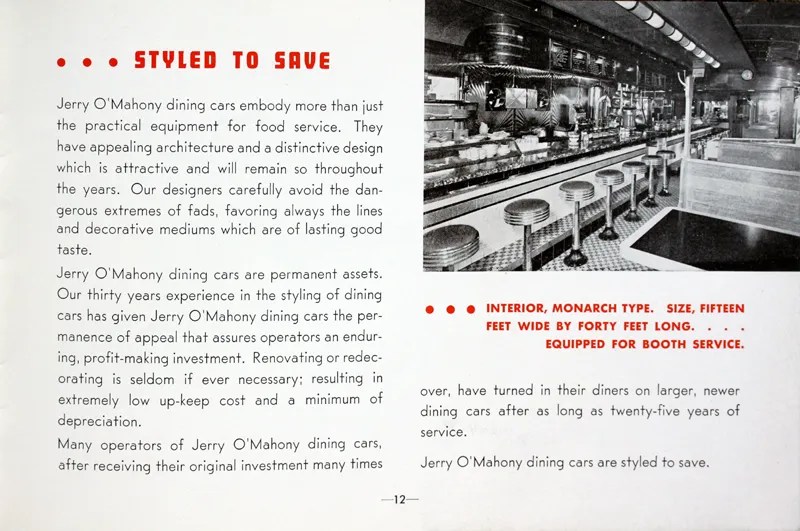
*** Interior, Monarch type. Size, fifteen feet wide by forty feet long. Equipped for booth service. ***

Photobucket
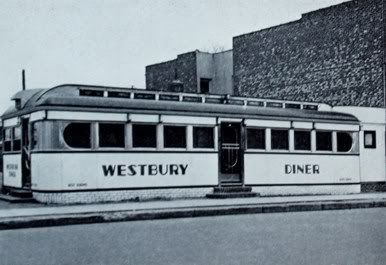
There’s the Westbury diner in the foreground, I’d assume it’s the same diner as this one. Also identifiable is the Franklin Diner. Note the rounded corner monarchs and the squared corner, stained glass windowed monarchs side by side.

Photobucket

IN OUR LINE WE LEAD THE WORLD

Jerry O’Mahony, Inc. Operates the largest, most up-to-the-minute dining car factory in the world.
Large though our plant is, all building operations are so co-ordinated that every detail in the construction of a Jerry O’Mahony dining car is carefully supervised by one of the founders of this firm.

Many of the men who build Jerry O’Mahony dining cars have “come up from the ranks” in our employ. After years of apprenticeship these men have become craftsmen unexcelled in their trade.

To build a dining car for you, that is to last for thirty years, and to incorporate, as we do, all of the modern improvements, we employ the ultimate in craftsmanship, and use the best materials obtainable. Modern machinery and up-to-date methods assure lasting construction.

Come, visit our plant. Watch our craftsmen at work, notice the materials, – the tools they use. See for yourself why we can say, “In Our Line We Lead the World”.

Photobucket

Photobucket

DURABILITY

Jerry O’Mahony dining cars are built to last for thirty years! In the selection of materials, the first consideration is durability. Only the finest material is used in construction.
The steel structure and the fabrication of West Virginian oak is the result of years of research in the building of better dining cars.

The exterior, which is porcelain-enameled, trimmed with copper or stainless steel, perfectly insulates our dining cars against moisture and imparts the lustrous beauty for which jerry O’Mahony dining cars have become famous.

The interior of every Jerry O’Mahony dining car is designed both for beauty and practicality. Floors of ceramic tile and side walls and counter step of mosaic tile in color combinations that harmonize with the Bakelite ceiling and Mexican mahogany trim, make a beautiful, long lasting interior. Alumilite window sash, stainless steel equipment and backwall, and the built in Bakelite hood all combine to make Jerry O’Mahony dining cars the most attractive and easily maintained of eating places.

Photobucket

Photobucket

COFFEE MAKER

Coffee is your most important item. With this in view we have designed an economical, automatic coffee maker that achieves the ultimate in the consistent brewing of good coffee. The self controlled features and our drip system assure the brewing of good coffee at all times, with a minimum of effort. This coffee maker is thermostatically controlled.

STEAM TABLE

Easily accessible, the stainless steel steam table or electric food container in each Jerry O’Mahony dining car is complete with insets, covers, roll cover and double-walled warmer. Thermostatic control permits the prolonged storing of cooked food without shrinkage or loss of flavour.

Storage cabinet and display case

Modern Jerry O’Mahony dining cars are equipped with a large, modernistic, stainless steel refrigerator. In addition to this, a new feature in our dining cars is the reach-in storage and display case. Centrally located behind the counter, its accessibility speeds service. Equipped with stainless baine-marie pans and an overhead glass display case, with sliding doors and slanting mirrors, this auxiliary refrigerator keeps your supplies fresh and increases the sale of your most profitable items.

Photobucket

O’Mahony was founded in 1913, so celebrating 30 years would date this to c. 1943.


Some closeups from other pages
If you have any idea as to where any of these diners were located, or if any are still around, please comment.

Photobucket

Photobucket
Barrel roofed “Victory” model. Older style stools, and a sliding door. I wonder what the actual date of manufacture of this particular diner was. Interesting that this barrel roofed style with the skylight vents on the roof, that is so associated with 1920s and early 1930s diner style is still offered in the early 1940s.

Photobucket
Interior with washrooms.

Photobucket
The terrace grill, a square cornered monarch model. Interesting that they’re advertising this older style monarch alongside the newer, streamlined one. I wonder how the demand for this type was at the point the brochure was published.

Photobucket
dining room setup

Photobucket
interior of the fairview

Photobucket
Fairview diner, an extra long monarch model

Photobucket
Westbury Diner, a monarch model with curved and an end door

Photobucket

It seems that the monarch name is used exclusively now to describe O’Mahony’s like this one, but the way the copy is worded here, it seems more like monarch was O’Mahony’s general model name for any monitor roof diner they produced, while “victory” was the model name for their barrel roof models.

Frazer Diner- Frazer, PA

I was sent these pictures by my old man, who visited on Friday.

The Frazer diner is a 1935 O’Mahony, originally located in and named the Paoli diner. (Paoli is also the home of the Philadelphia curling club, where I’ve spent a lot of time). It was moved in 1957 to its current location, just down the road, in Frazer. It was renovated/restored in 2002.
A photo of it before the work was done, showing the old awnings, can be found at:
http://www.agilitynut.com/p/frazer.jpg
A photo of the old neon sign can be found at: The American Roadside
Photobucket

Photobucket

Photobucket

Photobucket

The Charcoal Pit- original location – North Wilmington

The Charcoal Pit Tradition dates back to September 1956 when it first opened its doors. The “Pit” – referred to by loyal customers, became such an instant success that only after three months from the grand opening, it was decided to build more room for its long line of hungry customers. The “Pit” went from a small four table and a counter burger joint to a 115 customer-seating establishment.

http://charcoalpit.net/

Photobucket

Photobucket
PhotobucketPhotobucket